
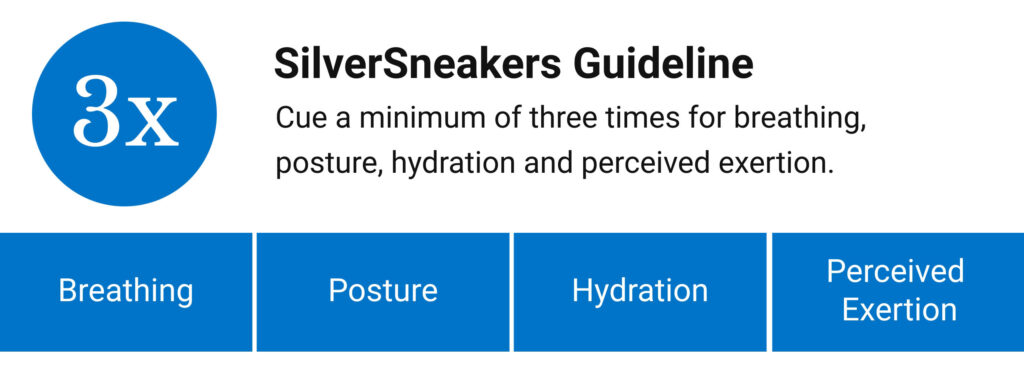
While SilverSneakers Mobility is a lower-intensity exercise class, maintaining safety is still essential. With the number of older adults living with multiple chronic conditions steadily increasing, instructors should consistently use the “minimum 3x” reminders—breathing, posture, hydration, and —perceived exertion in every SilverSneakers class to help support participant safety and comfort.
Breathing cues
- Cue for continuous breathing throughout class, avoid breath holding.
- Encourage exhalation on exertion phase of exercise during resistance training to discourage blood pressure spikes.
- Any verbal interaction and feedback that takes place with your participants will encourage consistent breathing. During your class, a fun and intentional way to discourage breath holding is to ask your students to count down repetitions with you (i.e., 4, 3, 2, 1).
Posture
- Use cues that encourage upright posture like “sit tall,” “bring the chest up with shoulders back and down,” “lengthen the spine, reaching the crown of the head toward the ceiling.”
- Encourage participants to sit forward on the chair without the support of the chair back when it is safe to do so. This simple forward body placement will encourage a more upright posture and greater activation of core muscles.
Hydration
- As we age, our thirst mechanism begins to deteriorate, so reminders to drink before, during or after exercise become extremely important for the older adult.
- If your participants do not bring water to class, encourage them to drink water before and after exercising.
- If your participants bring water to class, we highly recommend giving them at least three opportunities to hydrate during class. Consider giving even more water breaks if your class offers higher intensity options or if the weather is dry or hot.
Perceived Exertion (PE)
- Cue a minimum of three times for perceived exertion throughout class using a modified Perceived Exertion (PE) scale to help participants monitor the difficulty of movements, rather than physical exertion alone.
- This scale uses a 1–3 rating system to reflect how an individual feels during the activity.