
Understanding Joint Mobility and Stability
To design safe and effective SilverSneakers classes, you need to understand how mobility and stability work together throughout the body. While every joint requires both, each joint typically prioritizes one more than the other.
Mobility refers to a joint’s ability to move freely through its available range of motion. Stability refers to a joint’s ability to remain controlled and supported during movement.
For your participants to move well, they need the right balance between the two. Some joints are designed to move more, while others are designed to provide stability. When a joint that should be mobile becomes stiff, the body may compensate by creating movement in areas that should remain stable, often increasing strain on the lower back.
By understanding this relationship, you can make more informed programming decisions, especially when working with older adults.
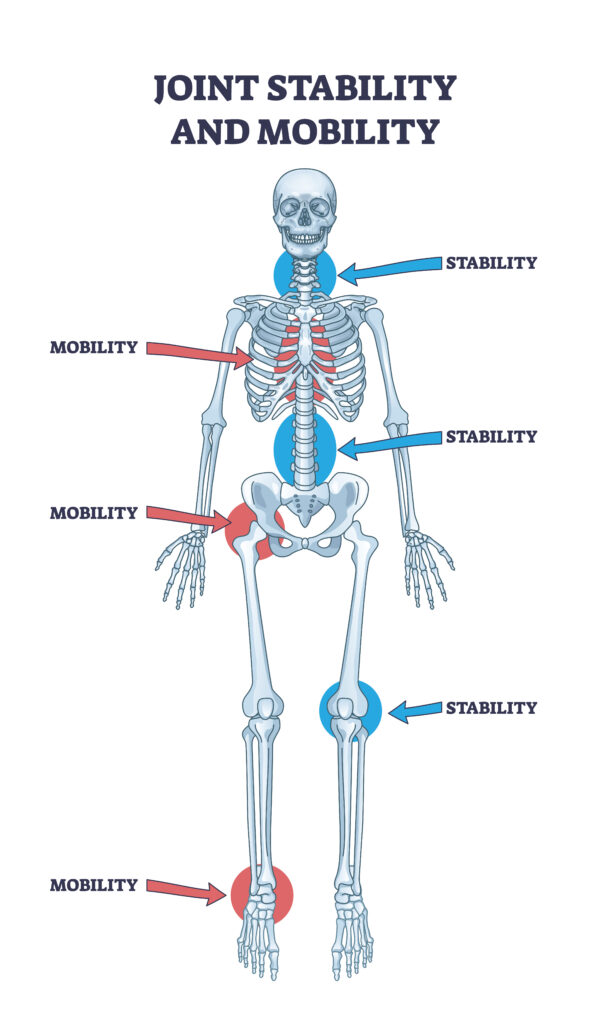
The Mobility–Stability Pattern (Head to Toe)
The body follows a general pattern of alternating mobility and stability:
- Neck → Stable
- Thoracic spine → Mobile
- Lumbar spine → Stable
- Hips → Mobile
- Knees → Stable
- Ankles → Mobile
- Feet → Stable
When one area isn’t moving or stabilizing as expected, the body often shifts that demand elsewhere which may be the back.
Applying Mobility and Stability in Your Class Design
As you design your classes, think about where you can apply mobility and stability to support your participants:
- Encourage mobility in the hips, thoracic spine, and ankles
- Reinforce stability through the core, lumbar spine, knees, and feet
If you notice limited mobility in a joint that should move, you can prioritize gentle exercises that support range of motion. At the same time, reinforce stability in joints that are meant to provide support, especially during strength or dynamic movement.
When you maintain this balance, you help participants move more efficiently and with less discomfort.
Key Programming Considerations
- Encourage movement at the hips and upper back rather than the lower back
- Balance mobility work with stability-focused strength exercises
- Progress exercises gradually while maintaining alignment and control
- Offer options so participants can move within comfortable ranges
Use these principles to support spinal health while allowing for natural, efficient movement.
In the next lessons, you’ll build on this foundation by developing muscular endurance, strength, and power exercises that reinforce joint control, posture, and functional movement.