
Understanding how steps connect to the beats of the music aids in creating effective combinations for warm-ups, cool-downs, agility and coordination combinations, dance moves and cardio training routines.
Continuous flow and smooth transitions between movement combinations keep the class flowing together, improving cardiovascular endurance and coordination skills. Choppy transitions can feel disconnected, or worse, cause a tripping hazard. Understanding three basic movement patterns to music will help you create flawless transitions. The three basic movement patterns are:
- Step-something.
- Something-step.
- Neutral movements.
Step-something
Step-something movements are when a step occurs on the first beat and continues with every other beat, or the odd numbered beats. The “something” – or action, occurs on the even beat.
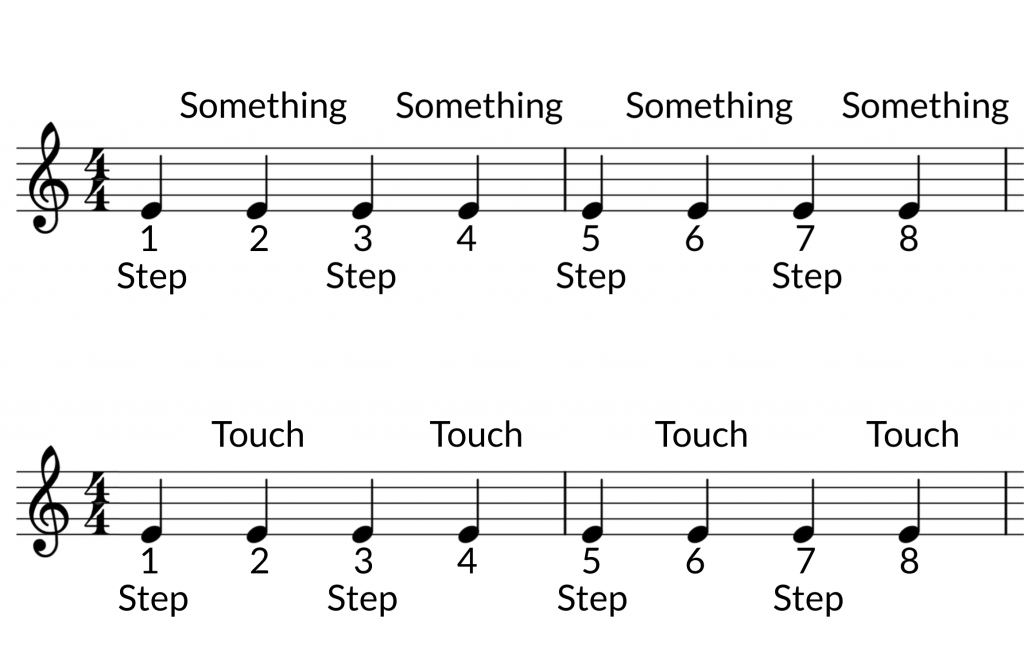
The following video demonstrates step-something movements with the “step” on the odd beats (1-3-5-7) and the “something” movement on the even beats (2-4-6-8).
Because a step-something movement begins with a step on the first beat of music, it can sometimes feel awkward moving from a march in place to a step-something. Step-something movements originate from cardio classes that utilize a step platform. It feels more natural to begin a movement on the first beat, stepping on to the platform. When done on the floor, such as in a standard cardio class, the first step on the first beat requires exceptional cueing to prepare the participant for the first step down in the movement.
Something-step
Something-step movements are when the action occurs on the first beat and continues with every other beat, or the odd numbered beats. The action occurs on the odd beat.
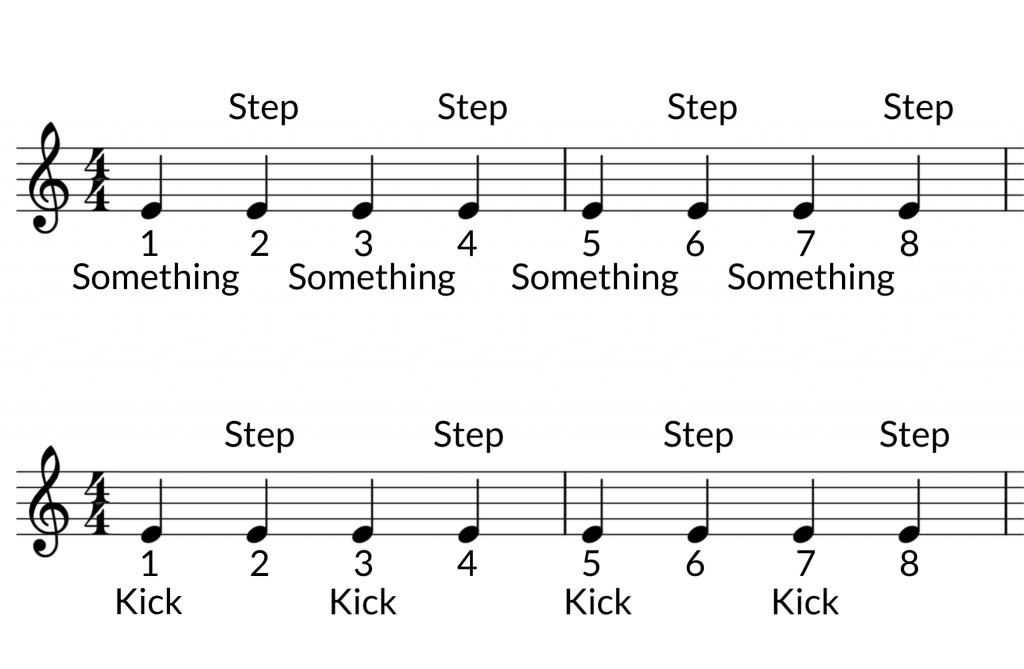
The following video demonstrates something-step movements with the “something” on the odd beats (1-3-5-7) and the “step” movement on the even beats (2-4-6-8).
Combining step-something and something-step movement patterns
Generally, a step-something and a something-step movement do not flow together in time with the music because a full movement, or step, cannot be completed with the musical beats. If a cardio routine feels disconnected, a step-something and a something-step may be combined in an awkward movement pattern. It takes time and practice to feel the beats of music with the movements.
The following video demonstrates a step transition combining a step-something and a something-step with lack of understanding of how the movements are coming together. Notice if you can follow smoothly or if the movements feel disrupted.
The same movement combination will be practiced a second time, demonstrating awareness of stepping in time with the music for continuous and smooth flow.
Exercises taught in video demonstration:
- 2x out-out-in-in
- 4x step touch
- 4x knee lift
- 4x hamstring curl
The step touch and the knee lift don’t flow together smoothly.
- 2x out-out-in-in
- 4x step touch
- 4x step – knee lift
- 4x step – hamstring curl
The hamstring curl and the out-out-in-in for both examples…that is instructor choice. If you know what you are putting together and you cue it well, it can work either way.
Neutral movements
Neutral movements maintain equal weight distribution on both feet, allowing the next movement to transition easily on the beat to be a step-something or a something-step.
Below are examples of neutral transitions.
Example of neutral steps:
- Squat in place.
- Double heel lift or bounce.
- Double toe lift or taps.
- “Hula hoop” – hip circles while feet stay in place.
- Hips side to side while feet stay in place.
- An upper body movement or routine while feet stay in place.
* A march/walk in place may be included as a neutral movement as one can easily transition into a step-something or something-step movement.
Key cardio transition takeaways:
- Smooth transitions result when one step connects to another step with fluidity. Such transitions are easy to follow and reduce risk of injury.
- Poor transitions are difficult to follow and can lead to injury. Avoid selecting steps that do not fit together, do not flow well or feel choppy.
- Incorporate neutral movements into the exercise combination to connect steps that do not flow together.
- Prepare and practice.
Instructor tip: Smooth transitions will lessen the risk of injury and maintain continuous movement, benefiting your participants health- and skill-related fitness goals.
Smooth transitions with resistance exercise: entry-action-exit
When choosing resistance exercises to create a combination, the entry-action-exit (EAE) method is recommended for continuous movement. The entry is the starting position of the exercise. The action is the rhythmic variations and repetitions used in the set. The exit phase is where and how the exercise will end. Think about how one exercise will end and the next will begin to create a smooth transition and continuous movement.
The following video will demonstrate exit-action entry examples of the exercises listed below.
Exercises used in the video demonstration:
- wrist circles
- biceps curl
- rotator cuff
- bent arm side raise
- reach front: lift-pour-up-down
- shoulder shrugs
- squat
- hip-hinge deadlift
- row
- triceps extension
Instructor written practice: Strength variations
Download the “Entry-Action-Exit” form. Review the video practice from upper body combination 1.
Using the grid, write out:
- The entry position of each exercise.
- The action (rhythmic variations, repetitions or other variations).
- The exit position that safely allows for a smooth transition to the entry of the next exercise.
Tips for resistance tool transitions:
- Consider both the tool (weights, resistance tube, SilverSneakers ball, chair) and the exercise.
- Apply the EAE (entry-action-exit) method of transitioning.
- If an exercise takes longer than 10 seconds to set up or transition to, think about how to bridge the exercise with another movement to improve the flow.
- Complete each repetition of an exercise before transitioning to the next exercise.
Instructor tip: Knowing the number of beats per step/movement will help you place each combination into a musical phrase.