
Group exercise classes attract a wide variety of skills and physical abilities. For those managing chronic conditions, each day may present various challenges. The ability to reach each person where they are on any given day requires the effective use of variations. These are choreography tools used to create progressions (making a movement more challenging) and regressions (making a movement easier) for each exercise or movement combination.
Numerous variations can be created to make an exercise easier and more manageable or to challenge a participant’s abilities and provide a progressive overload, improving their functional skills, cardiovascular strength and muscular endurance. Exercises and movement combinations can be progressed, regressed or have a new look and feel by changing one simple aspect over time.
Learning how to apply each of these variables to exercise or movement combinations empowers participants to self-select what is appropriate for their fitness level and ability, helping them reach both short-term and long-term fitness goals.
The ACE Group Fitness instructor handbook (2016) uses the acronym DRILLS to help remember such variations.
(See the SilverSneakers continuing education online training Strength Progressions for Group Exercise for examples.)
Variation
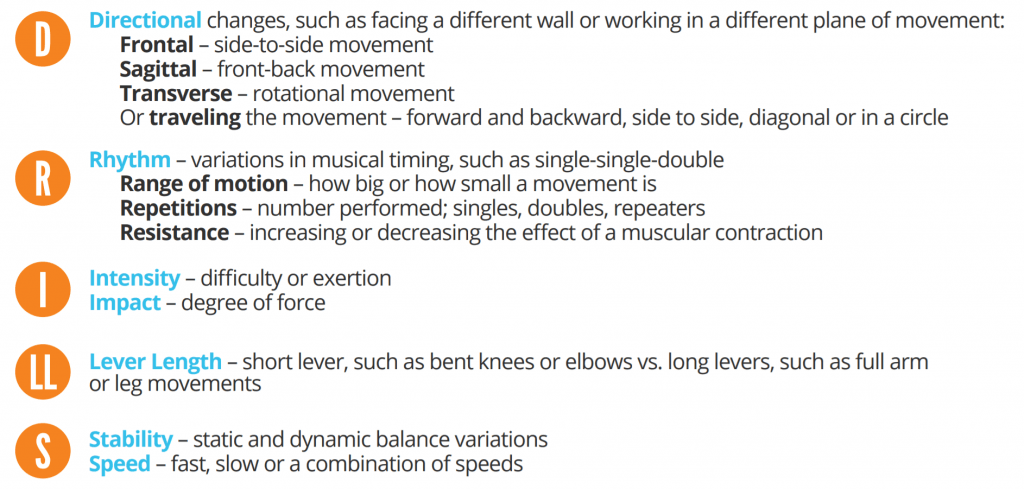
When creating variations for progressions, regressions or challenges, always be aware of safe transitions for active agers. Know what movements are high-risk and contra-indicated for the class format and population being taught. Instructors are responsible for considering the risk vs. benefit of all exercises and variations provided for class participants.
Instructor writing practice: Creating variations
Practice the skills previously discussed by creating variations.
- Download and print the “Creating Variations” form.
- Note the examples provided and watch the videos to see how the exercises were combined into a movement pattern.
- Write out a variation, an additional movement and another variation to create a movement combination.
- Put on your favorite group fitness CD or playlist and practice the combination you created, refining the movements, repetitions and transitions until you feel it is ready to share with your class.
The next three videos demonstrate examples of movement add on and variation in an exercise combination. Use these examples to practice the different variations and use them to inspire you to create additional exercise combinations appropriate for your class.
Movement – Out-out-in-in
Variation – Speed: Quick out-hold-quick in-hold
Add on movement – Knee lift right and left
Variation – Repetitions: 4 knee-repeater right
Movement – Alternating tap -step
Variation – Direction: Alt tap front-side-back-step down
Add on movement – Alternating heel-dig front
Variation – Repetitions: Double heel-dig R-L
Movement – 2-2 Squat in place
Variation – Speed: Pulse down 3-1 squat
Add on movement – Alt reverse lunge 2-2
Variation – Rhythm: Reverse lunge – knee lift – lunge – step in