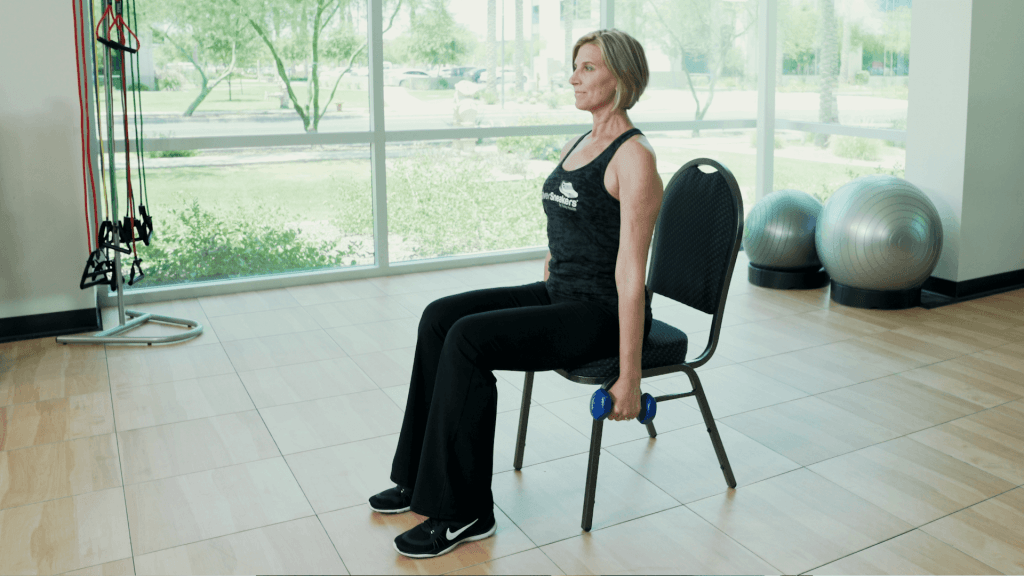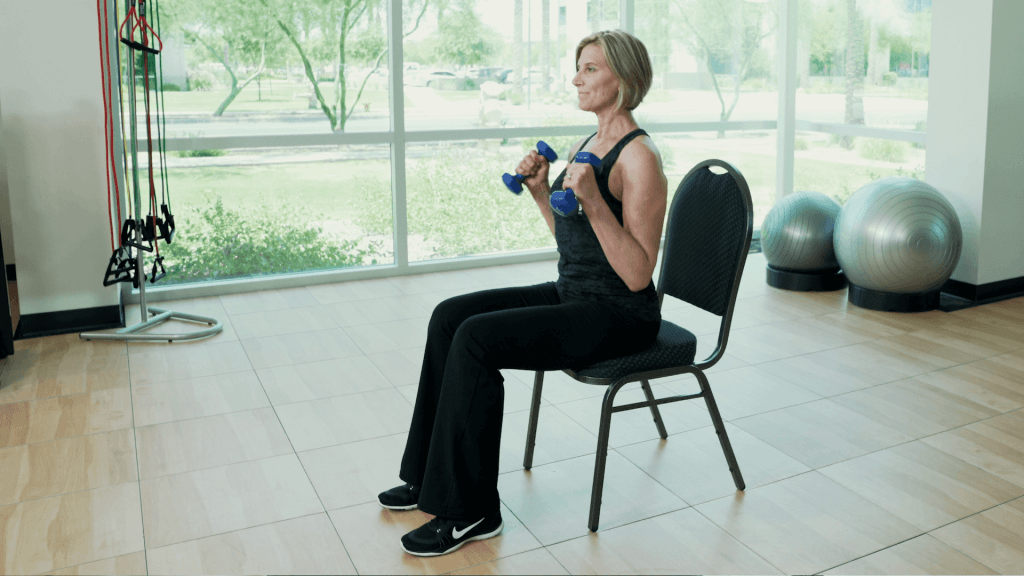
In this lesson you will learn principles of selecting safe and progressively challenging exercises.
- Focus on exercise selection and the risk versus benefit concept.
- Think about your cues for the SilverSneakers Strength Position and the impact they have on members’ form technique and alignment.
- Complete the 3 questions and 2 tables on this lesson in the unit study guide.
SilverSneakers offers a variety of classes to meet a wide-variety of participant needs. From classes that incorporate a chair for seated or standing support to functional training classes designed for the active member, instructors must work closely within their setting and with their members to determine which class format best fits members’ needs.
When implementing classes, remember to follow training principles for improvement:
- Specificity: To be effective, the type of exercise must be specific and targeted toward the goal or activity you wish to improve. In the exercise science community, this is referred to as the SAID principle, standing for specific adaptation to imposed demand. This principle says that the type of demand (or stress) placed on your body dictates the type of adaptation that will occur. It is the basis for exercise selection and other components of training to assure your goal is reached. For example, if the goal is to run a marathon, then the practitioner would engage in running activities.
- Overload: The principle of overload states that a greater than normal stress, or load, on the body is required for training adaptations to take place. Overloading body systems with higher work rates and increased loads cause the body to respond to these extra demands by improving its performance. Without the stimulus of overload, even a well-designed program will see limited improvements.
- Progression: If a training program is to produce higher levels of performance, the intensity of the training program must become progressively greater. In other words, to keep seeing benefits you must progressively increase the stimuli. If you do not progress, your body no longer perceives an overload and you will plateau.
Functional Movement Patterns
Functional training prepares the body for activities performed in daily living. Functional training optimizes movement by encouraging progression and overload techniques while optimizing stability and efficiency.
Functional training is the way we train muscles and joints to work together during complex movement patterns involving multiple muscles and joints at once. Functional training incorporates multi-planar movement for optimal efficiency. For strength exercises to effectively transfer to other movements, several components of the training movement need to be similar to the actual performance movement. This includes coordination, planes, types of muscular contractions (concentric, eccentric, isometric), speed of movement and range of motion.
Functional Movement Pattern
Description
Exercise Examples
Bend and Lift
Bending is a movement pattern where you bend your torso by hinging your hips. Picking something up from the floor is an example of bend and lift.
- Deadlift variations
- Squatting
Single-leg movements
Single-leg movements incorporate unilateral action of the lower body. Single-leg movements occur when you climb stairs, walk, or balance on one leg.
- Lunging
- Balancing knee raise
Pulling
Pulling movements require engagement of the muscles of the back. Drawing something toward the earth against resistance, or drawing something toward the body is a pulling movement.
- Tubing Pull-Down
- Bent over rows
Pushing
Pushing movements involve your upper body. You can push forward, overhead, or to the side. Opening a door or putting an object on a shelf are examples of pushing movements.
- Overhead press
- Chest press with tubing
Rotation
Rotational movements are basic twisting exercises, such as twisting to throw a ball or swing a golf club.
- Torso twisting
- Diagonal reaches
Exercise Selection for Safety and Effectiveness
Safety is a key component of SilverSneakers classes. By being mindful of exercise selection, managing chronic conditions, and coaching for proper mechanics and alignment, instructors can help create a safe environment and reduce the risk of injury.
Instructors are responsible for weighing the benefits and risks of the movement patterns and exercises they program. While some “high risk” movements may be found in daily activities, instructors should avoid teaching these types of movements within the group exercise class setting. Providing exercise leadership to a group is different than working one-on-one.
SilverSneakers has identified movement patterns that possess a high degree of risk for the general older adult population as depicted in the chart below.
Recommendation
Definition
Risks
Alternative
Limit the number of bilateral overhead arm movements
Movements where both arms go over the head with resistance
Shoulder injuries; blood pressure elevation
Limit bilateral overhead arm movements with resistance to no more than 8 repetitions. Count aloud or cue for forceful exhales during the contraction phase to mitigate blood pressure response. Lift one arm at a time or choose a different exercise.
Avoid exercises that cause excessive forward flexion at the hip
Hip flexion beyond 45 degrees in a seated position and 90 degrees standing
Low back pain and injury; blood pressure decrease if head is below heart level
Cue “bringing ribs half way to the thighs” in a seated position. Use a ball between the ribs and the legs in a seated position to provide a tactile cue.
Use caution when programming inversions
Movements where the head is below the heart
Blood pressure decreases if head is below heart level; lightheadedness; dizziness, fainting
Keep the head above the heart for more sedentary, frail participants. Keep the head above the heart for individuals with known low blood pressure or heart conditions.
Avoid jamming or locking joints or forcing joints into stretch
Forcing a joint beyond its unassisted range of motion; moving a joint in a way that compromises stability
Bone fracture; joint injury
Perform stretches unassisted or without external force or pushing. Use caution when exercising on carpet. Use caution when teaching movements that require quick, repetitive movements or quick directional changes.
Avoid Overuse
Excessive repetitions of an exercise or movement
Joint injury and muscle fatigue
Limit resistance movements to no more than 24 variably paced repetitions of an exercise. Avoid excessive marching in a seated position. The shoulder and hips are involved in most movement patterns. Avoid too many exercises for the same region of the body without rest.
Muscle Balance Principles
Daily activities, such as sitting, or performing repetitive movements or training techniques, can contribute to muscle imbalances. In older adults, tight muscles may include the hip flexors, hamstrings, pectorals, anterior deltoids, and abdominals. Lengthened or overstretched muscles include the spinal erectors, scapular retractors (rhomboids and mid-traps), and posterior deltoids.
To help improve muscle balance, consider:
- Continuously encourage correct postural alignment.
- Utilize exercises that will strengthen muscles that are typically weak, and stretch muscles that are typically tight.
- A 2:1 approach to exercise selection. Choose more exercises or repetitions to strengthen commonly weak muscles and more exercises or repetitions to stretch commonly tight muscles. For example, the weaker muscle groups will benefit from 16 repetitions and the stronger muscle groups will still be effectively stimulated and improve in strength with eight repetitions.
Weaker Muscles
strengthen, more repetitions
Stronger Muscles
stretch, consider fewer repetitions
Triceps
Biceps
Retracting back muscles
Chest muscles
Hamstrings
Quadriceps
Tibialis anterior (shins)
Calf muscles
Movement Technique
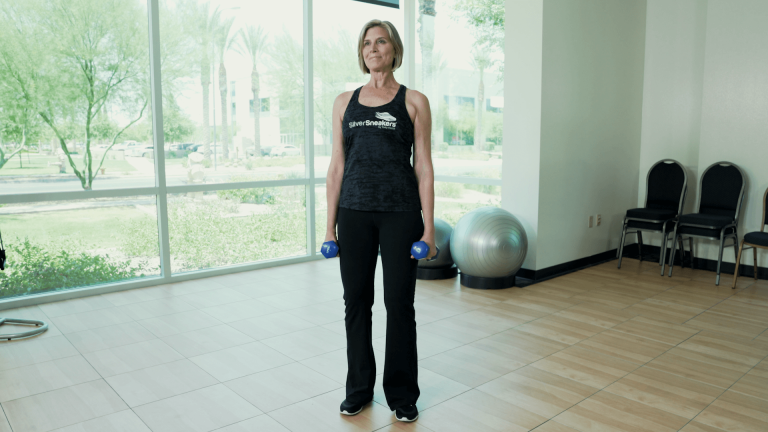
Exercises must be performed in a position that optimizes safety and support. You must demonstrate correct seated and standing posture. We refer to this position as SilverSneakers Strength Position.
Instructor demonstration is an important part of teaching safe and effective exercises. SilverSneakers Strength Position provides a framework for how you should physically demonstrate an exercise to optimize communication of movement execution. This technique includes physical posture, form, and alignment for every exercise selected within a group exercise class. You are encouraged to teach from a standing position through each class, and ask participants to perform movements in a standing position a minimum of three times in class formats that utilize a chair.
When standing:
- Feet should be hip-width apart to provide a solid base of support for the body.
- Maintain neutral spine when performing the exercise.
- Firm abdominals to support the lower back.
- Avoid locking knees.
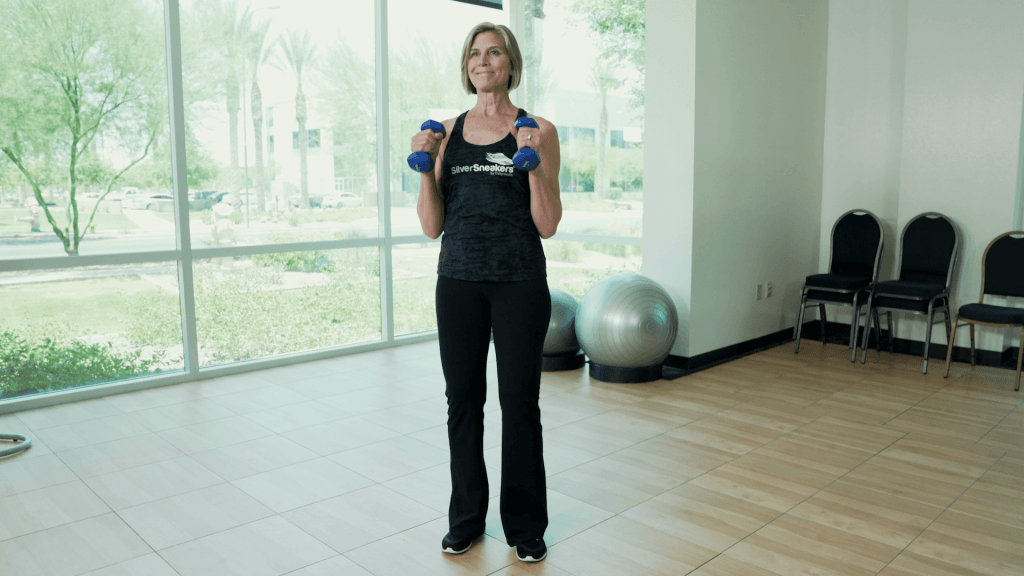
When seated:
- Feet firmly planted on the floor.
- Sit forward to engage core support.
- Tall spine with neutral shoulders.
- Firm abdominals to support the lower back.
Base position adaptations are encouraged for progression and intensity variation. Remember to cue for posture a minimum of three times during every class.