
While everyone can’t agree on a definition of stress, all of our experimental and clinical research confirms that the sense of having little or no control is always distressful – and that’s what stress is all about.
The American Institute of Stress
The basis of stress management strategy is providing effective tools to help individuals take control of their lives in both small and significant ways. We can manage thoughts, emotions, lifestyle and the process by which we deal with difficulties and problems. No matter how stressful life may seem at any given moment, there are steps that can be taken to relieve the constant pressure long-term stress creates so we can regain control of life.
A big part of successful stress management involves triggering the opposite of the stress response – the relaxation response – which can help us by lowering blood pressure, slowing our breathing down, decreasing heart rate and diminishing the release of stress chemicals.
One important thing to remember is the fact that stress management is not one-size-fits-all. It is a good idea to experiment with different techniques in order to find the strategies that are best for you.
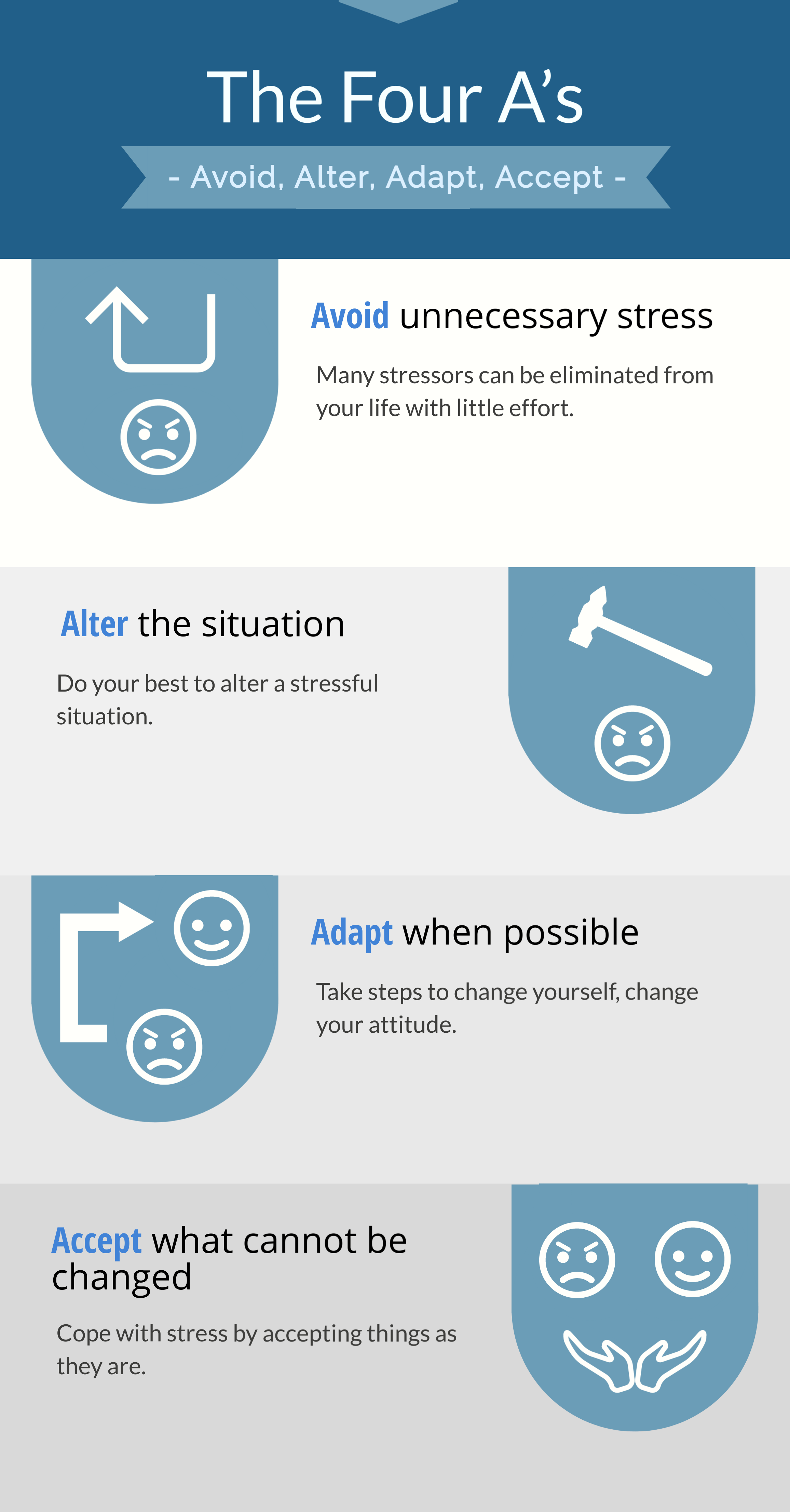
The Four A's – Avoid, Alter, Adapt, Accept
When stress begins to weigh us down, it can feel like we are carrying a load that gets heavier with each step. With all the roles we play and the responsibilities we carry in life — as a member of a community and an integral part of the lives of our family and friends — we can become overwhelmed by stress before we even understand that we have a problem. When our stress levels exceed our ability to cope, we can begin to restore balance to our lives by identifying the source of our stress. After recognizing where our stress is coming from, we can take steps either to change the situation itself, or to change our reaction to it.
The following stress management principles can lead us down the road toward effective self-care, allowing us to remain active and focused so we can avoid the burn out that long-term stress can bring.
Avoid unnecessary stress
We cannot avoid all stress, and it can be unhealthy to avoid any situation that needs to be addressed, but you may be surprised by the number of stressors you can eliminate from your life with little effort.
- Learn to say “no.”
We can avoid a lot of stress by learning to say “no” when we already have too much responsibility and too many demands placed on our time.
- Take control.
Another great strategy for avoiding excess stress is to take control of your surroundings. For example, if you know there may be traffic on your route, be prepared to leave early or take a longer route on a less-traveled road. If the evening news makes you anxious, turn it off.
- Avoid people that stress you out.
If there is someone in your life that constantly causes you stress, take steps to improve the relationship. If this is not possible, it can lower your stress level if you limit the amount of time you spend with that individual.
- Work on prioritizing your “to do” list.
Analyze your daily schedule. If you have more on your plate than you can possibly accomplish, take some time to distinguish between the “must do’s” and the “should do’s.” Set your priorities for the day and drop any tasks that aren’t truly necessary until a later date, or eliminate them completely.
Alter the situation
If you find that you cannot avoid a stressful situation, do your best to alter it. Take the time to think about strategies that might change your situation for the better.
- Communicate your feelings before they become overwhelming.
If there is someone or something that is bothering you, communicate in a respectful and honest manner. Resentment can build if feelings are bottled up inside for too long. It can be helpful to use “I” statements. For example, “I feel frustrated that class often does not start on time. Is there something we can do to change the situation?”
- Be willing to compromise.
When you ask someone to make changes to their behavior, be willing to do the same. Work to find a middle ground.
- State limitations in advance.
You might begin your class by saying, “Because of the special event after class, we’ll be ending five minutes early. Be ready to put away your SilverSneakers chair and resistance tools a little earlier than usual so we can enjoy our time together.”
- Learn to manage your time well.
No one likes to feel rushed all the time. Your reward for efficient time management is less stress and more opportunities to do the things you love. Effective time management gives us “extra” time and helps lower stress levels..
Adapt when possible
If you can’t change the stressor, take steps to change yourself. Modifying your expectations, even working to change your attitude, can help you regain a sense of control.
- Focus on the positive.
When stress feels overwhelming, take a moment to reflect on things you appreciate in your life, including your own gifts and positive qualities. Focus on something that brings you joy, like children, pets, vacation time or making a difference in the lives of your SilverSneakers class members.
- Adjust your standards.
Perfectionism can be a major source of chronic stress. Demanding perfection from yourself can cause frustration and guilt. Set reasonable standards for yourself and others.
- Try to reframe stressful issues or problems.
Look at your situation from a new or different viewpoint. Instead of feeling discouraged that you are in a traffic jam, try to appreciate the opportunity you have to pause, listen to your favorite music or enjoy some “alone time.” Actively attempt to diffuse a stressful situation by turning your viewpoint around to the positive.
- Look at the big picture.
Find perspective by asking yourself, “Will this matter in a month or a year? Is it worth getting upset over this issue?” If the answer is no, focus your attention elsewhere. This realization can make you feel more in control while making a stressful situation less overwhelming.
- Practice “thought-stopping.”
If you notice yourself falling into a negative thought pattern, stop gloomy thoughts in their tracks. Replace thoughts that do not benefit your state of mind with mindful moments of breath focus or thoughts that bring you happiness.
Accept what cannot be changed
Some stress is unavoidable. When this is the case, the best way to cope with stress can be to accept things as they are. Acceptance can be difficult, but in the long run, it is more effective than trying to control situations you cannot change.
- Share your feelings.
Although you may not be able to change the situation or solve the problem that is bringing you stress, your feelings are legitimate. You may find that your stress levels decrease significantly after talking it out with a trusted friend or family member.
- Practice forgiveness.
Accept the fact that the world is imperfect and people make mistakes. Anger and resentment take energy. Forgiveness can free you from negative energy and emotions.
- Learn from your own mistakes.
Try to reframe challenges as opportunities for personal growth. Although we can’t change what has already taken place, we can learn new strategies to help us stop making the same errors again and again.