
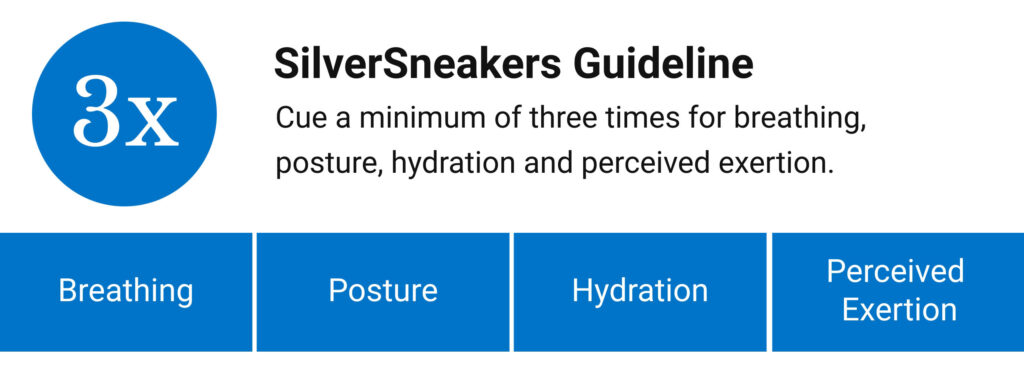
The number of older adults living with multiple chronic conditions is steadily increasing. To help manage safety in this population, instructors should consistently incorporate the minimum 3x reminders for posture, breathing, perceived exertion, and hydration into every SilverSneakers class.
Breathing Cues
Encourage continuous, steady breathing throughout the entire class. Remind participants to avoid holding their breath, especially during more challenging movements or poses.
- Use simple verbal cues such as, “Keep breathing,” or “Inhale… exhale…” to promote rhythmic breathing.
- Talking with participants, asking for light feedback, or using a conversational tone can naturally encourage them to breathe more consistently.
- When holding a pose, such as Warrior 2, consider counting down from five or cueing, “Take two breaths here” to guide participants through the hold while maintaining calm, steady breathing.
- Breath slowly, without strain or struggle
- Our breath should be smooth, steady and continuous
- Allow your breath to unlock tension you may have in your body
- Inhale and lengthen through the spine, exhale and relax the shoulders
During the Relaxation phase, shift to restorative breathing cues. Use soft, calming language to promote deeper, more mindful breathing to support relaxation and recovery.
Be careful not the overdo breathing, especially during inhalation, as this may lead to lightheadedness, dizziness, irritability, nausea and headaches. Hyperventilation may result from a sudden, excessive intake of oxygen. Encourage slow, effortless breathing, without strain.
Posture
Use clear, positive cues to encourage upright posture, such as:
- Lift the chest, draw the shoulders back and down
- Lengthen the spine by reaching the crown of the head toward the ceiling
Encourage participants to sit slightly forward on the chair—away from the backrest—when it is safe to do so. This forward position promotes a more upright posture and naturally increases core muscle engagement. Without back support, maintaining posture becomes a gentle but effective core workout.
Instructors should cue for core engagement to help protect the lower back. Emphasize spinal elongation and extension, which supports back strength and helps address common postural concerns such as thoracic kyphosis and forward head posture.
Hydration
Provide participants with at least three (3) opportunities to hydrate during class. Offer additional water breaks if the class includes higher-intensity options or if the environment is especially warm or dry.
As we age, the body’s thirst mechanism becomes less effective, making it easier to become dehydrated without realizing it. For this reason, regular reminders to drink water during class are essential for the health and safety of older adults.

Modified Perceived Exertion (PE) for SilverSneakers Yoga
In SilverSneakers Yoga, instructors use a Mind & Body Perceived Exertion (PE) scale to help participants monitor the difficulty of movements, rather than physical exertion alone. This scale uses a 1–3 rating system to reflect how an individual feels during the activity.
PE Scale Overview:
- Zone 1: Feeling good, relaxed, and confident
- Zone 2: Warmed up, breathing a bit deeper, stretching more, and feeling gently challenged
- Zone 3: Straining, out of breath, overexerting, or feeling off balance
It’s okay for participants to occasionally reach Zone 3, such as during balance challenges. However, time spent here should be brief and intentional.
Why It Matters
- The Mind & Body PE chart is a valuable tool for instructors to monitor and adjust intensity, helping reduce participant risk and improve safety.
- Referring to the chart during class allows instructors to adapt exercises in real time, ensuring movements remain appropriate for the group’s needs.
Best Practices for Instructors
- Review the chart at the beginning of class or during pre-class instructions. Set expectations for participants to check in with their own bodies and provide honest feedback.
- Encourage self-awareness rather than imitation. Avoid saying things like, “I’m a 2 on the chart. What number are you?” This may cause participants to match your intensity instead of listening to their own body.
These foundational safety and teaching strategies are essential for every SilverSneakers Yoga instructor. In the next unit, we’ll explore SilverSneakers Yoga Class Leadership to help you create effective, engaging, and well-structured classes.