To make SilverSneakers Yoga classes both effective and safe, we have created a list of exercises to avoid. The following checklist of high-risk poses or movements for SilverSneakers Yoga is not exhaustive and does not include every high-risk movement that can be executed. While these movements should be avoided, continue to apply risk vs. benefit exercise selection principles when choosing poses or movements for your classes.
Inversions requiring the head to go below the heart
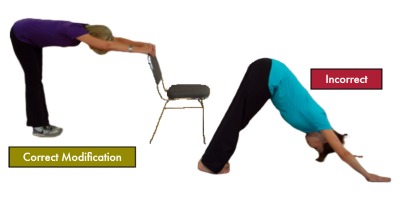
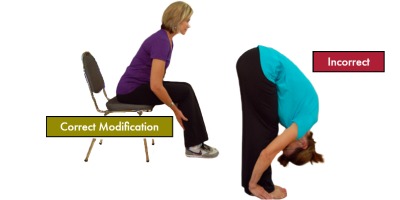
Yoga postures that bring the head below the heart are risky for the older adult population.
Avoid poses such as:
Arm balances like handstands or headstands
Forward Bends or Folds with the head below the heart
Mat-based Downward Facing Dog
Retrieving water from the floor without sitting first
Overuse of a joint or muscle group
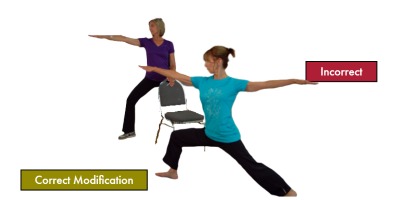
Overuse of joints or muscle groups can occur when holding postures for too long. A slow count of five (two to three breaths) is recommended to gauge a safe amount of time for holding postures and stretches. The following images illustrate the proper modifications to ease strain on joints and muscles.
Avoid poses such as:
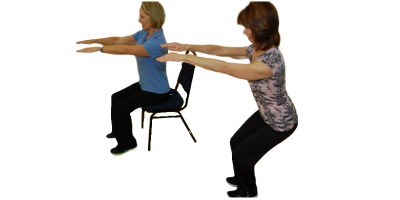
Chair Pose with arms extended forward for an extended period or overhead beyond pain-free range of motion
Sustained shoulder extension or abduction in Warrior 1 and Warrior 2
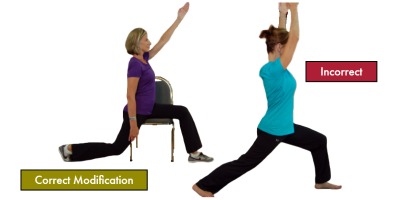
Sustained knee flexion
Sustained knee flexion (i.e., holding a posture for extended periods) can cause eventual joint or muscle pain. Therefore, cueing for a slow count of five (two to three breaths) is recommended. The following images provide modifications to ease knee strain.
Additional exercises where sustained knee flexion can occur include:
Chair Pose
Warrior 2
Extended Side Angle
Pigeon Pose
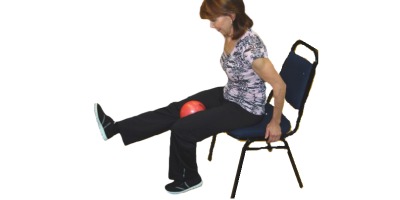
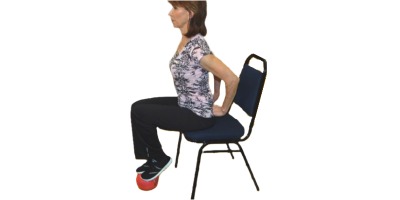
Double leg lifts
Avoid seated exercises with both feet unsupported) off the floor. Lifting both legs simultaneously in a seated position places excessive strain on the sacrum and low back. Below are safe modifications that can be shared in class.
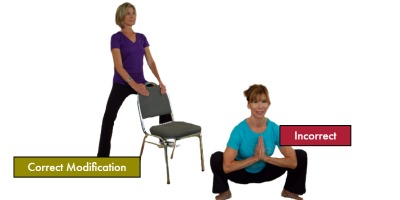
Full squats or deep knee bends
Avoid postures where the angle of knee flexion is less than 90 degrees in a standing position, otherwise known as a full squat.
Also avoid the following posture:
Garland Pose or deep squat (squat with extreme knee flexion and hip hinge)
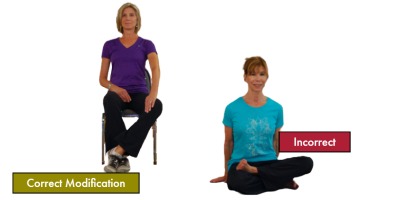
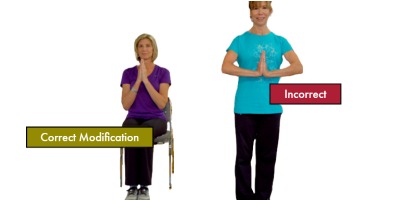
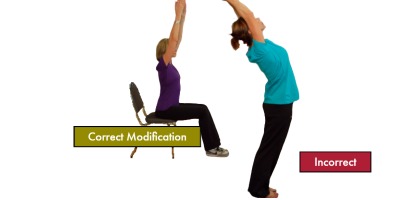
Hyperflexion and/or hyperextension of joints
Below are examples of common yoga poses that may cause joint hyperflexion and hyperextension. The images also illustrate options to modify postures.
NOTE: Degrees of movement and joint angles are determined from anatomical neutral. Forced hyperflexion or hyperextension of a joint angle occurs when applying external force to achieve a greater range of motion and/or hold a joint position.
Examples include:
Neck hyperextension – cervical extension great than 30 degrees
Excessive flexion of the shoulder joint greater than 180 degrees
Forced hyperflexion of the wrist – greater than 90 degrees (e.g., hands heart center with elbows lifted)
Forced knee hyperflexion (e.g., Standing Half Lotus with hand pulling foot into groin)
From a seated position, forward flexion at the hip greater than 45 degrees
From a standing position, forward flexion at the hip greater than 90 degrees
Hyperextension of the lumbar spine at the waits greater than 30 degrees.
Breathing Techniques to Avoid
Avoid these breathing techniques or practices, as they pose a high risk for older adults.
Constricted Thoracic Breathing
Though not an exercise in and of itself, shallow, rapid and irregular respiration indicates constricted thoracic breathing and is often associated with stress and tension. When we’re under stress, breathing patterns can change, causing those experiencing stress to take shallow, small breaths from the chest.
Practicing slower, longer belly breaths using the diaphragm more efficiently can trigger the parasympathetic nervous system’s “rest and digest” response, turning down the stress response. Practicing other types of focused breathing techniques, such as lengthened exhalations and “three-part” breathing, can greatly reduce the habit of unconsciously engaging in the more constricted, stress-driven thoracic breathing pattern.
Suspension/Holding Breath
Remind class members to breathe. Our goal is to teach our members to breathe smoothly and evenly during the flow of asanas or poses. Participants are often tempted to “hold” their breath when “holding” a pose.
Fiery Breathing techniques
Includes Bellows Breath (Bhastrika) and Breath of Fire (Kapalabhati). Avoid any technique that encourages forceful inhalations, or rapid and forceful exhalations. The pressure created during these techniques increases blood pressure and is potentially dangerous for anyone with a heart condition or glaucoma.