Warm-Up and Range of Motion
The Warm-Up and Range of Motion segment of class is 5–10 minutes in length and includes three essential components: centering, breathwork and movement.
- The centering portion is a participant’s introduction to class and a time to share encouragement and build connections. Encourage participants to focus inward, quiet distractions and be present for class. The centering portion allows for seamless transition into breathwork.
- In the breathwork portion, the focus shifts to practicing different breathing techniques and the introduction of pairing movement with breath. Breathwork is important for both the nervous and cardiovascular systems.
- The movement portion prepares participants for the work segment through the movement of larger muscle groups and the encouragement of connecting movement with breath.
Centering
The centering portion of class helps participants gently transition into class and invites them to connect with their breath, body, and inner awareness before movement begins. Seated in a chair, this moment of mindfulness may include setting a personal intention—but it can also encompass themes such as feeling grounded, self compassion or sharing the benefits of yoga.
Use inclusive and empowering cues to guide this process:
- Practice yoga with patience and positivity.
- If a pose or sequence is unfamiliar, give yourself permission to observe first.
- This is your own personal practice. Honor your body by celebrating what it can do and respecting any limitations.
- Move slowly. Give your brain time to build new mind-body connections.
- Using a chair for support offers all the benefits of yoga – improved balance, posture, strength and flexibility.
- Feel free to come out of a pose or take a break at any time; returning to this space of centering.
- Move within your own pain-free range of motion and follow any medical guidance.
Breathwork
Breath awareness is one of the most important foundations of SilverSneakers Yoga. Bringing attention to the breath anchors the mind in the present moment and supports relaxation. Because breathing is directly linked to both the nervous and cardiovascular systems, instructors should offer gentle guidance to participants who may be unfamiliar with deep or focused breathing.
Like the centering segment, the breathwork portion is also done seated and includes two to four simple breathing techniques to help participants focus, calm the mind, and prepare the body for movement.
Participants may breathe in and out through the nose, or inhale through the nose and exhale through pursed lips. Encourage participants to either close their eyes or soften their gaze to reduce visual distractions and deepen their inward focus.
Important Breathing Reminders
Be careful not to overdo breathing, especially during inhalation, as this may lead to lightheadedness, dizziness, irritability, nausea and headaches.
Hyperventilation
Hyperventilation may result from a sudden and excessive intake of oxygen. If you can hear yourself inhaling, you are trying too hard. Breathe in slowly and effortlessly and without straining.
Focus on Exhalation
Like inhalations, exhalation play a key role in healthy breathing. Emphasizing a full, mindful exhale can:
- Improve the depth and quality of inhalation
- Help lower heart rate and blood pressure
- Support the release of stale air, toxins, and tension from the body
Encourage participants to engage the abdominal muscles—drawing them inward and upward—to assist the diaphragm and fully empty the lungs.
Active Breathing Techniques (Seated Toward the Front of the Chair)
For the following breathing exercises, participants should sit tall near the edge of the chair with a natural lumbar curve. A small prop, like a ball at the lower back, may offer comfort and support.
Thoraco-Diaphragmatic Breathing (Diaphragmatic Breath)
Place hands on the sides of the rib cage with the middle fingers close together.
- Inhale: Expand the rib cage; the fingers gently move apart.
- Exhale: Release the breath; the fingers return to their starting position.
Barrel Breath
Clasp the hands and rest them on the thighs.
- Inhale: Breathe deeply into the ribs while lifting the arms to shoulder height, shaping them as if wrapping around a barrel.
- Exhale: Slowly lower the arms.
- Option: Once warmed up, participants may lift the arms overhead for a full-body stretch.
Complete Breath (Three-Part Breath)
This breathing method encourages full lung capacity through a mindful, layered approach.
- Inhale: First fill the belly (lower lungs), then the rib cage (middle lungs), and finally the chest (upper lungs).
- Exhale: Reverse the flow—release air from the chest, then the rib cage, and finally engage the core to fully empty the lungs.
For the following breathing exercise, participants should sit back in the chair and maintain a relaxed, tall posture.
Abdomino-Diaphragmatic Breathing (Belly Breathing)
Place hands gently on the belly.
- Inhale: Allow the belly to rise under your hands with each inhalation.
- Exhale: Gently draw the belly in with each exhalation.
Instructor Cues for Breathwork
- Let your breath be smooth and steady, not forced.
- Lengthened exhales promote calm, releases tension and can help prevent dizziness.
- If you feel lightheaded, return to your natural, effortless breath.
- Allow your breath to quiet your mind and relax your body.
- Breathe into the front, back and sides of your body.
- If your mind wanders, that is ok. Gently guide your attention back to your breath.
Movement
This segment bridges the transition between centering/breathwork and the Work phase of class. It serves to:
- Increase core temperature
- Stimulate oxygenated blood flow
- Promote joint mobility and elasticity
Participants may remain seated or standing based on ability, preference, or class design.
Begin with Large Muscle Groups
Start by warming up the body’s larger muscle groups—shoulders, hips, thighs, abdomen, chest, and back—before progressing to smaller or more isolated movements. Maintain an emphasis on upright posture and alignment throughout.
Coordinate Movement with Breath
Encourage participants to match one movement with each breath—typically:
- Inhale: for upward or expanding movements
- Exhale: for downward or contracting movements
Repeat each movement sequence four to six times, allowing participants to find a rhythm that works for them.
This practice of linking movement and breath is known as a vinyasa. In yoga, vinyasa refers to a smoothly flowing sequence of poses performed with intentional breath coordination. The term comes from Sanskrit, meaning “to place in a special way,” emphasizing purposeful, mindful movement.
For beginners, this breath-movement coordination may feel challenging. Remind participants that continuous breathing is the top priority, and the ability to link breath to movement will develop with time and practice.
Teaching Tips
- Begin seated to build confidence and body awareness
- Include 1–2 breathing techniques from the Breathwork segment
- Add dynamic stretching, especially for hips and shoulders
- Move the spine through all five directions: flexion, extension, lateral flexion, rotation, and elongation
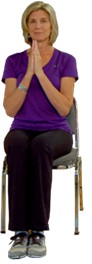
Hands to Heart Center (Anjali Mudra)
Bringing the hands together at the chest is a gesture or mudra often used to calm the mind, relieve stress, reduce blood pressure, and lower heart rate. When the palms meet in this position, they help connect and balance the right and left hemispheres of the brain.
In our postures and vinyasas, you’ll notice that we often return to this position—hands together at heart center—at the beginning of class, to start or end a sequence of movements, or simply to find a moment of stillness and calm during practice.