
What is mindfulness and why is it important?
With mindfulness and meditation coming more into the mainstream over the past few years, it can be helpful to look at what the terms really mean and understand how we can use these practices in our day-to-day life to manage stress and improve overall health and feelings of well-being. With all the information available on the topic, it can be difficult to come to an understanding about mindfulness.
Mindfulness can be practiced both informally – at virtually any place and time – and formally — in a more structured time and location. A moment of mindfulness can be practiced in any situation throughout the day. In contrast, a more formal meditation practice usually takes place for a specific amount of time in a more formal space.
…a moment-to-moment awareness of one’s experience without judgment. In this sense, mindfulness is a state and not a trait. While it might be promoted by certain practices or activities, such as meditation, it is not equivalent to or synonymous with them.
The American Psychological Association
Mindfulness practices have been around for a long time, entering the American mainstream in the last 40 years. Much of the recent popularity can be traced back to Dr. Kabat-Zinn’s work on Mindfulness-Based Stress Reduction (MBSR). Since the launch of MBSR in 1979, thousands of studies have documented the physical and mental health benefits of mindfulness. This documentation on the real-life benefits of mindfulness has driven the practice to a larger audience.
Mindfulness is not turning the brain off and tuning out reality. Instead, it provides a way for our minds to focus on something specific — the breath, the beauty of nature — allowing our brains and bodies to calm down and decompress from stress. This gets us out of the stress loop in which we often find ourselves. It is more of a laser focus than an “off” switch. Mindfulness is not about clearing the mind, it is about bringing focus to our thoughts without judging them or assigning values like “good” or “bad.”
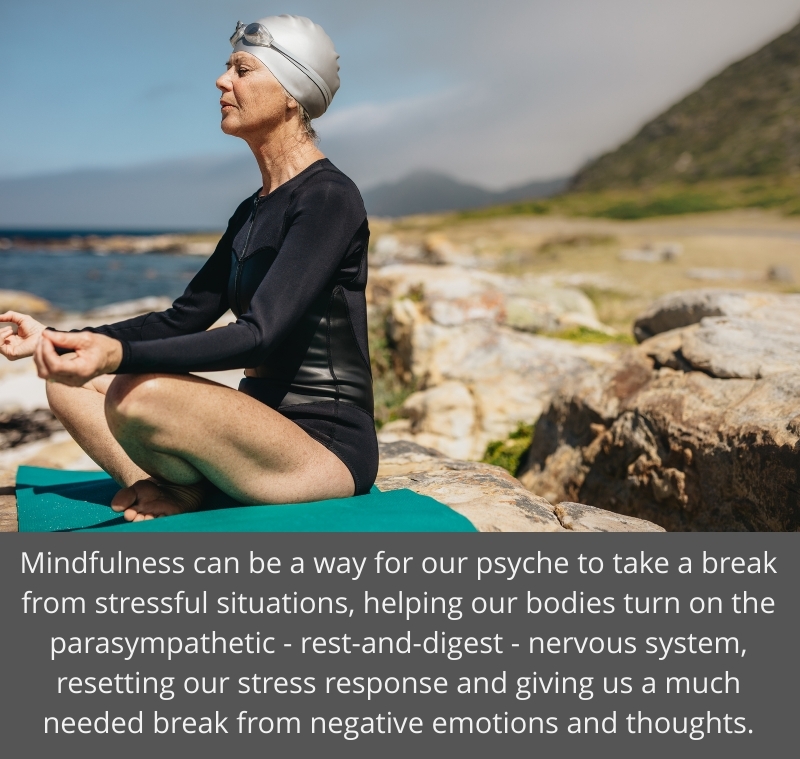
Mindfulness is simple, but not easy. Often, the rush of our busy lives does not allow us the opportunity to slow down. If mindfulness becomes a consistent practice, research tells us we will be able to manage stress more effectively and we will increase our span of attention during the day. Even common household tasks can become an opportunity for a moment of mindfulness. For example, when washing the dishes, we can notice the feel of the water — warm or hot to the touch — the sensation of the bubbles, the texture of a plate. We can even pay attention to our posture as we stand at the sink, taking deep and even breaths. Mindfulness is paying attention to an activity in the moment without allowing our mind to wander to our to-do list or our dinner menu. It minimizes thoughts that can distract us from the present moment. Consistently practicing mindfulness while performing day-to-day activities can help us stay more focused throughout our day, lowering our stress and increasing our ability to think clearly.
It’s not really about sitting in the full lotus, like pretending you’re a statue in a British museum. It’s about living your life as if it really mattered, moment by moment by moment by moment.
Kabat-Zinn, 2010
How to practice mindfulness
In order to practice mindfulness effectively, no fancy or expensive tools are necessary. This is one of the reasons why the practice can be such an effective tool for you and your members. We can spend as little as 30 seconds on mindfulness, or we can take over an hour to reflect. We focus our minds in many ways, whether we are paying attention to a beautiful image, the expression on the face of a friend or our breath.
Awareness and acceptance of the present are the two key components common to every definition of mindfulness used in research.
Medina, 2018
Although mindfulness is available to us every moment of the day, there are a few things you need to know in order to set yourself, and your SilverSneakers class members, up for success:
- Find a quiet place.
The mind is easily distracted, so it is beneficial to find a place that is as free from distractions as possible. Silence your phone and do your best to get away from the bustle of life. During SilverSneakers classes, avoid loud, distracting music for mindful moments. Instead, opt for more ambient, flowing, gentle tunes. Set the stage for success in your class by closing the doors and minimizing outside noise. Dimming the lights can help minimize sensory input and encourage focus, but if you choose to do so, make sure that there is enough light in the room for students to safely exit the class, if necessary.
- Get comfortable.
There is no special chair or pillow that will quiet the mind. You may choose to sit comfortably or to lie down. It’s often easier to stay awake with an active mind when we are in a seated position, so if you tend to drift off to sleep while practicing mindfulness, it’s often best to sit upright in a comfortable position. The SilverSneakers chair is a great place to spend time in mindfulness practice, especially in class formats like Classic, Circuit and Yoga. In SilverSneakers formats that incorporate floor options, like BOOM MIND or MUSCLE, you can choose to create a mindful experience on the mat.
- Notice your body and feel your breath.
Paying attention to your body and the flow of your breathing is a wonderful way to begin your mindfulness session. There is so much to do during the day that we often do not pay attention to what is going on inside our head or to how our body is feeling.
- There is no way to completely quiet your mind.
The goal of mindfulness is not clearing or emptying the mind. The purpose of mindfulness is to pay attention to something — you get to choose the object of your attention — with curiosity, openness and acceptance.
- Your mind will probably wander.
As you begin to pay attention to your body and mind in the present moment, chances are that many thoughts will begin to arise. Mindfulness training can assist us in our search for more focus. When you notice you are becoming distracted, bring your focus back to the breath and the body, as many times as necessary, without getting discouraged.
The more you make mindfulness a consistent practice, the better you will become at taking control of your attention. Additionally, consistent practice of mindfulness techniques can help you be more aware of the times during the day when you are operating on auto-pilot.
In the next unit, you’ll have the opportunity to experience several different ways to practice mindfulness.