To successfully teach a multilevel class and meet the fitness goals of each participant, instructors should be knowledgeable with exercise variations that provide progressions and regressions. A progression adds complexity, difficulty or intensity to an exercise, while a regression decreases the complexity, difficulty or intensity of an exercise.
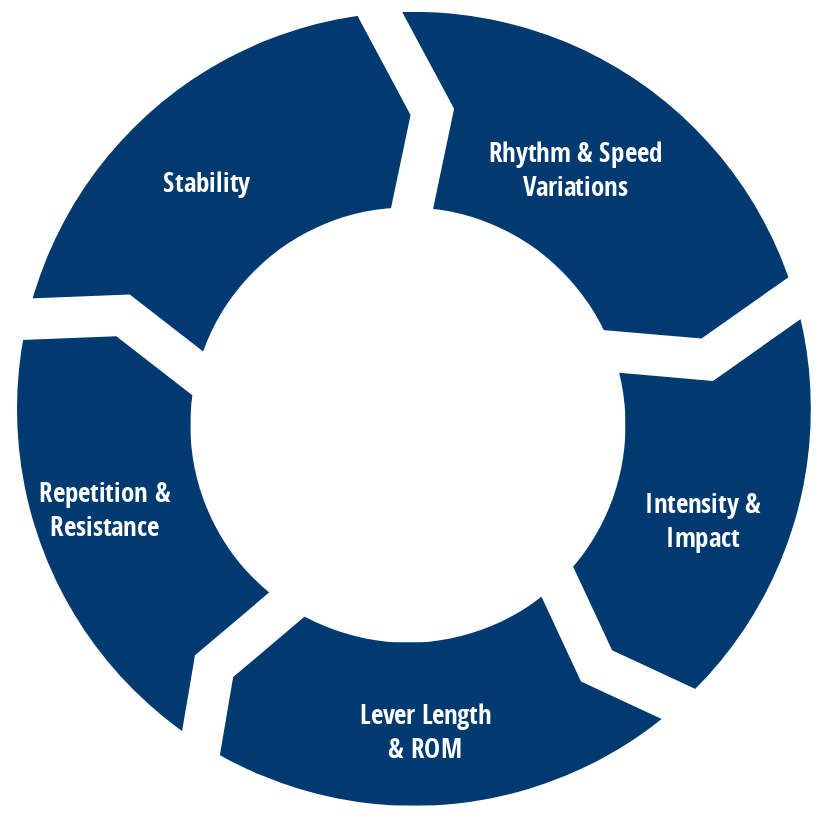
Applying progression and regression variations creates safe strength training progressions for older adults. Following are examples:
Resistance
Resistance is an increased force or load applied to a movement or muscular contraction. Resistance changes can be applied using:
- Increased handheld weights
- Increased resistance of tubing
- Inflation level of the six to nine-inch SilverSneakers ball
- Bodyweight and perceived effort
See examples of resistance variations below.
Repetition
Repetition is defined as the number of times a movement is repeated in a sequence SilverSneakers class guidelines recommend introducing an exercise at a slower tempo of two to four repetitions, followed by eight to 12 repetitions at varied rhythms and exiting the exercise with an appropriate isometric hold or pulse variation that allows for a smooth transition into the next exercise. This pattern provides safe movement transition in a group class while following accepted training principles for older adults. Following this principle can be achieved in a variety of ways. Using a biceps curl with handheld weights as an example:
- Right side only, 2x half-time curl
- Left side only, 2x half-time curl
- Right side only, 4x single curl
- Left side only, 4x single curl
- Right side only, 8x single curl
- Left side only, 8x single curl
- Both arms, stagger curl – up halfway and hold, up all the way and hold, down halfway and hold, down all the way and hold
- Transition to the next exercise
The above example uses both fewer and medium repetitions at a time, providing a brief rest period between sides, before finishing the set with a double arm movement pattern. Total repetitions: 15x per arm
See examples using repetition variations below.
Rhythm and speed variations
SilverSneakers classes are built on music. Music motivates, inspires and empowers us to work better. SilverSneakers strength classes recommend a beat per minute that varies by class format. Rhythm variations alter the tempo or style in a set of movements or exercises. Effective use of rhythmic and speed variations is a great way to provide an overload challenge.
Group exercise music is designed to work in 32-count phrases containing 8-count blocks. Rhythmic variations include:
- Tempo or “singles”
- Half-time or 2-2
- 3-1
- 1-3
- 4-4
- 1-7
- 7-1
- 8-8
- Stagger
- Double time or pulsing
- Zig-zag
See additional examples of using rhythm and speed variations below.
Lever length and range of motion (ROM)
Lever length is the distance between the axis and point of resistance application, or force. Range of motion (ROM) is defined as the full movement potential of a joint; a joint’s range of flexion and extension; the number of degrees that an articulation will allow one of its segments to move.
Depending on the muscle being worked and the axis point, sometimes variations can be made in lever length and sometimes not. Usually there are more options for variation in range of motion than lever length. For example, a biceps curl is a short lever movement. Not much can be changed in the lever. Hip abduction can be either a long lever movement, from the ankle to hip or a short lever movement from knee to hip. Variations in range of movement can be applied to both levers.
Examples of how these two principles might be applied in strength training follows:
Exercise
Lever Length
Range of Motion
Biceps curl
- Short lever from wrist to elbow
- Full ROM from extended arm to bending at elbow, pulling weights towards shoulder
- Small ROM: bottom half, middle, top half
Lateral arm raise
- Long lever from wrist to shoulder
- Short lever from elbow to shoulder
- Full ROM lifting wrists (long lever) or elbows (short lever) to side walls
- Small ROM: bottom, middle, top half
Leg abduction
- Long lever from ankle to hip
- Short lever from knee to hip
- Full ROM lifting leg out to side and up
- Small ROM
Examples using lever length and range of motion can be seen below.
Intensity and Impact
Intensity is how hard a person perceives their effort to be. Using the above variations will likely affect how the participant perceives the intensity of the work. Impact affects movements progressing from one foot remaining in contact with the floor during exercise increasing to plyometric activity. Impact options can be acceptable progressions to add in your SilverSneakers and BOOM classes. It is important to remember that it should only be offered as a progression from a base move that all can perform. A little goes a long way! Repetitive impact movements can place class participants at risk for pain or injury. Start with a non-impact or low-impact version of the exercise and progress with impact options from there, as appropriate for the class and group you are teaching.
Examples of intensity and impact variations include:
- Squat in place > alternating squat > jump squat
- Double pulse squat and stand > double pulse squat and stand to calf raise > double pulse squat and stand to jump
See additional intensity and impact examples below.
Stability
Stability is the ability to maintain or control joint movement or position. Stability is both achieved and challenged by the coordinating actions of surrounding tissues and the neuromuscular system. Upper and lower body strength exercises can be challenged simply by changing variations in stability.
Examples of stability progressions:
- Feet shoulder width apart
- Feet wider than shoulder width
- Feet together (narrow width)
- Feet staggered (semi-tandem, like standing on a railroad track with one foot in front of the other, shoulder width apart)
- Tandem – one foot in front of the other (like standing on a tight rope, space between front heel and back toe)
- Narrow tandem – one foot in front of the other (like standing on a tight rope, front heel and back to touching)
- Single leg stance
- Kickstand – 90 percent weight one foot, 10 percent on other
- Knee lift
See examples of stability options below.
Applying the variations discussed, instructors can provide progressive strength and functional skill improvements within a multi-level class. A resistance training class implementing the above variations can improve strength, balance and gait. This results in a decreased fall risk and increased independence, for a longer, healthier life.
A well-designed, progressive resistance exercise training program is well known to exert positive effects on both the nervous and muscular systems, resulting in improvements in muscle mass and muscle strength. Resistance exercise is the best treatment strategy for managing and preventing sarcopenia. While there are many components to an optimal resistance exercise program, exercise intensity, volume and progression are critical factors in successfully leading a multi-level SilverSneakers group training experience. You have the power to help our members live long, live healthy and be stronger longer.