The next consideration when planning your strength training class is the number of sets that should be performed. An exercise set refers to a group of consecutive repetitions performed for an exercise. One set of eight to 12 variably paced reps of an exercise is the minimum required for strength improvement.
Single-set strength training is an effective means of muscle development, particularly in the early stages of strength training. Resistance exercise volume is associated with greater improvements in lean body mass. Multiple sets may be necessary to produce strength improvements in older adults who are at higher training levels (Peterson; 2011).
SilverSneakers class guidelines recommend performing one set of eight to 12 variably paced reps for the exercise and tool being used. With the diversity of tools (hand held weights, elastic tubing with handles, non-weighted ball) and the SilverSneakers class format design, multiple sets using variations of resistance tools and rest opportunities are built in to the design of the class to elicit progressive strength gains.
For example, rather than doing two or three sets of biceps curls using hand held weights, SilverSneakers class guidelines recommend one set, introducing the exercise with two to four slower paced repetitions, followed by eight to 12 variably paced repetitions. A second set may be offered using the elastic tubing with handles. Changing the resistance tool and providing a “break” between sets for a muscle group is a safe and effective way to build muscular strength and endurance in older adults.
Larger muscle groups, such as the quadriceps and glutes, use more energy, are more susceptible to fatigue, and can cause higher blood pressure responses than smaller muscle groups, such as the biceps. While SilverSneakers class guidelines provide the flexibility for exercises to be done in any order, it is recommended to progress from larger to smaller muscle groups as it makes sense in your class plan.
SilverSneakers class guidelines recommend training all major muscle groups in each class. The following chart lists the major muscle groups to give attention to during each class, along with a sample exercise using one of the signature SilverSneakers exercise tools.
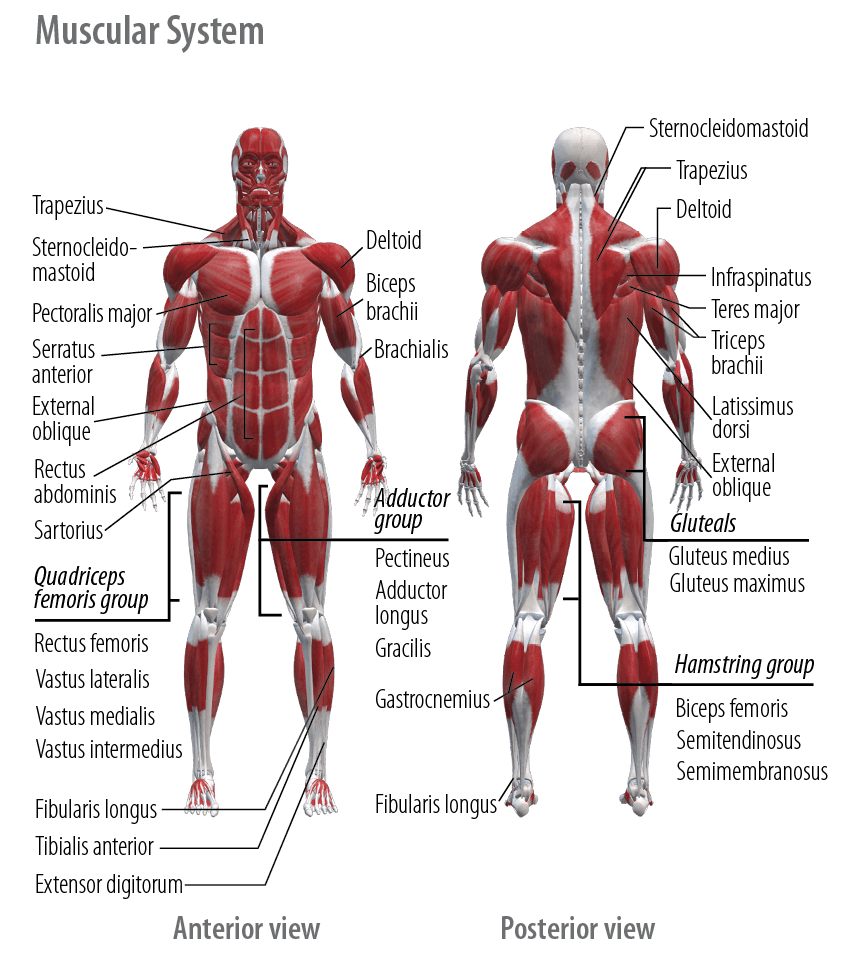
A variety of exercises and tools can be used to strengthen the body. The following video clips show sample exercises that target major muscle groups. Not all exercises are appropriate for all participants or class formats.
Chest (pectoralis major)
Chest flye with elastic tubing
Upper back (trapezius and rhomboids)
Shoulder blade squeeze with tubing
Shoulders (deltoids)
Front raise with weights (anterior)
Back (latissimus dorsi), chest (pectoralis major), teres major
Elbow/side body ball press (middle)
Shoulders (deltoids)
Bent over reverse fly with weight (posterior)
Front upper arm (biceps)
Biceps curl with weights
Rear upper arm (triceps)
Triceps extension with weights
Abdominals (rectus abdominis)
Seated crunch with ball
Low back (erector spinae)
Standing opposite arm/leg extension
Side body (internal and external obliques)
Standing rib cage to hip with tubing
Forearms (wrist flexors and extensors)
Wrist curls with hand held weights
Upper front leg (quadriceps)
Squat with weight
Upper back leg (hamstrings)
Seated hamstring curl with ball behind knee
Inner thigh (hip adductors)
Standing ball squeeze between thighs
Inner thigh (hip adductors)
Seated ball squeeze between thighs
Outer thigh (hip abductors)
Standing side leg abduction with ball
Outer thigh (hip abductors)
Seated side leg abduction
Calves (gastrocnemius)
Standing calf raise, body weight or weights
Calves (gastrocnemius)
Seated calf raise with weights
Shin/ankle (anterior tibialis)
Seated plantar flexion and dorsiflexion