
As you learned in Lesson 1.1, sarcopenia causes a decrease in strength and functional ability in older adults. According to An Aging Nation, the population of those 65 and older in 2015 was 47.8 million. The projected population of people 65 and older in 2060 is 98.2 million, with 19.7 million being 85 or older. The following information provides an overview of estimated impact on the older adult population, our economy and chronic conditions.
Sarcopenia and the aging population
- Though diet and exercise can reduce the rate of muscle and strength loss, even active older adults will experience decline in muscle function. (McArdle, Jackson; 2011)
- Age‐related muscle weakness dramatically increases the risk for elderly falling. A large number of those elderly who fall will not continue living in the community. One half of accidental deaths among individuals age 65 and older are related to falls. (McArdle, Jackson; 2011)
- The risk of disability is 1.5 to 4.6 times higher in older persons with sarcopenia than in older persons with normal muscle. (Janssen, Shepard, Katzmarzyk, Roubenoff; 2004)
- In 2015, 4.6 million jobs were held by men age 65 and older; 3.7 million jobs were held by women age 65 and older; with 5.3 million full-time workers age 65 and older. (Facts for Features: Older Americans Month; An Aging Nation; April 2017)
- Approximately 20 percent of the older U.S. population is functionally disabled. (Janssen, Shepard, Katzmarzyk, Roubenoff; 2004)
- In 2000, 1.5 million people were institutionalized, and 33 percent of these people were admitted to long‐term health care facilities because of their inability to perform activities of daily living. (Thompson; 2007)
- People with chronic illnesses and activity limitations caused by conditions like sarcopenia have more physician visits and fill more prescriptions than those individuals with no activity limitations, all of which presents a greater burden on our health care system. (Alliance for Aging Research; 2011)
- Healthcare expenditures due to sarcopenia cost roughly $900 per person per year. (Marcell; 2003)
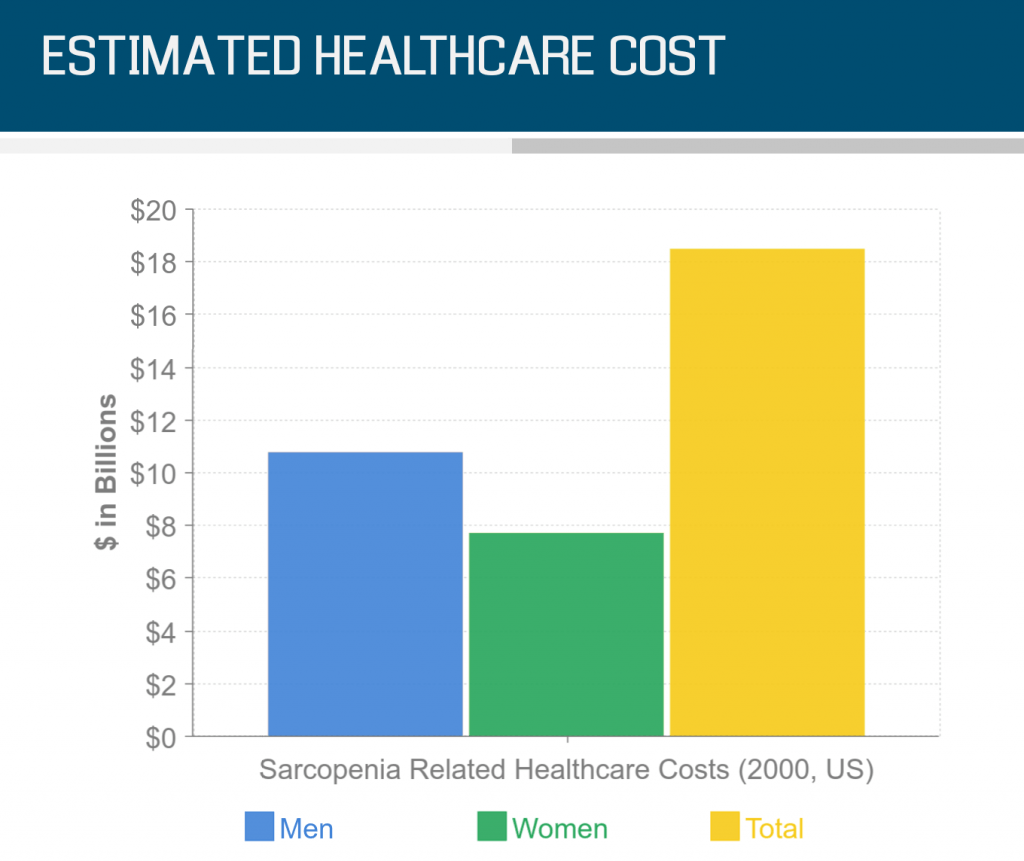
- The estimated direct healthcare cost attributable to sarcopenia in the United States in 2000 was $18.5 billion ($10.8 billion in men, $7.7 billion in women), which represented about 1.5 percent of total healthcare expenditures for that year. (Janssen, Shepard, Katzmarzyk, Roubenoff; 2004)
- The United States spends more than $26 billion annually on additional healthcare costs for people over 65 who lose their ability to live independently over the course of a single year. (Alliance for Aging Research; 2011)
Sarcopenia is associated with other chronic conditions
- Muscle loss has major health implications because it correlates with bone loss, physical dysfunction and metabolic slowdown. Body composition with lower muscular tissue and higher fat tissue is associated with obesity, osteoporosis, diabetes, high blood pressure, high blood cholesterol, heart disease, stroke, arthritis, low back pain and several types of cancer. (Wescott & Baechle; 2015)
- A loss in muscle mass is related to metabolic problems such as insulin resistance, type 2 diabetes and obesity. (Rivas, Fielding; 2011)
- Between 2009 and 2034, annual diabetes‐related spending is expected to increase from $113 billion to $336 billion. (Alliance for Aging Research; 2011)
- The annual cost of diabetes could rise to an estimated $192 billion by 2020. (Alliance for Aging Research; 2011)
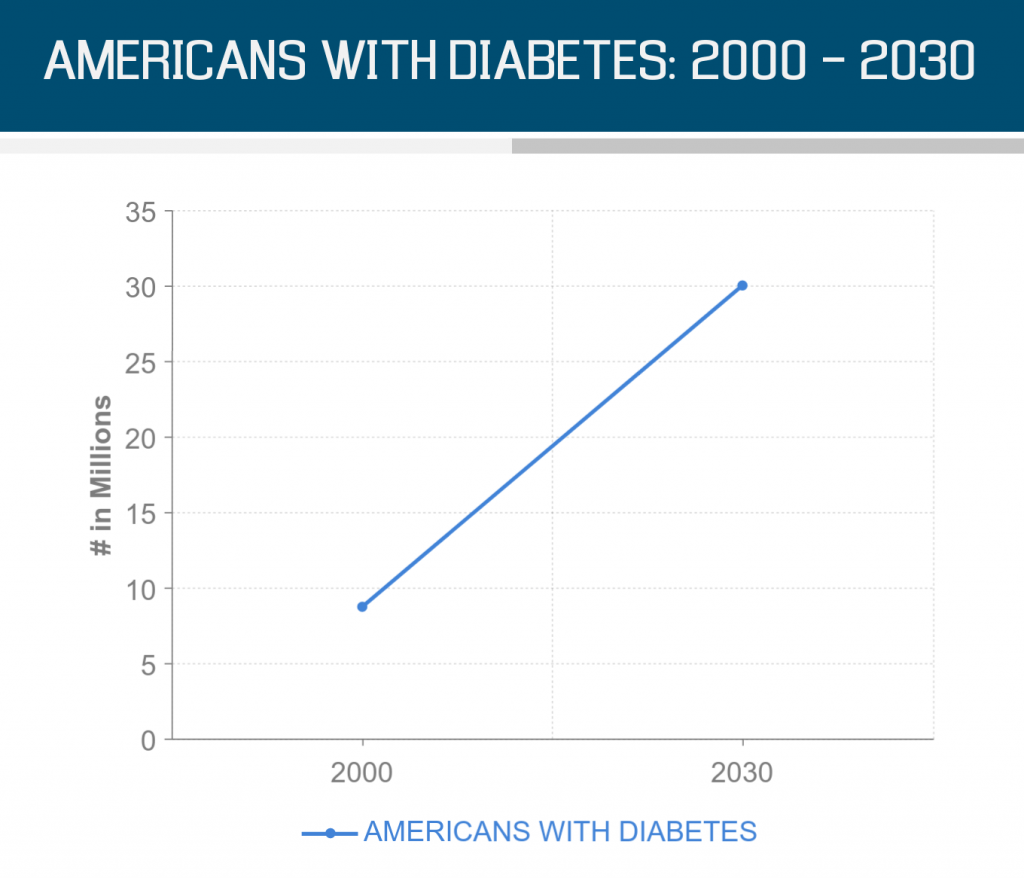
- By 2030, more than 30 million Americans could have diabetes – 71 percent higher than in 2000. (Alliance for Aging Research; 2011)
Although age‐related muscle loss is inevitable, therapies and interventions that can halt or reverse these effects may positively impact older adults. Though sarcopenia contributes to numerous other health problems and accounts for a similar percentage of healthcare costs as osteoporosis, no public health campaigns are directly aimed at reducing the prevalence of sarcopenia. (Janssen, Shepard, Katzmarzyk, Roubenoff; 2004) In addition, reducing sarcopenia by just 10 percent would save $1.1 billion. (Janssen, Shepard, Katzmarzyk, Roubenoff; 2004)
A progressive resistance training program has been found to be a powerful intervention in the prevention and treatment of sarcopenia. A well-planned SilverSneakers class providing techniques for exercise progression can be highly effective at increasing muscle mass, improving total body strength and decreasing fall risk in older adults.