
As an instructor, you are responsible for leading a safe and effective exercise experience. Since our classes are specifically designed for older adults, we ask that each instructor lead classes with professionalism and skill.
PACE
In Foundations, you were introduced to PACE, the SilverSneakers member engagement model. PACE guides your delivery of exercise options in each of your SilverSneakers classes. Considering the program goals for the class format you are teaching, lead your members in an experience that upholds our program standards.
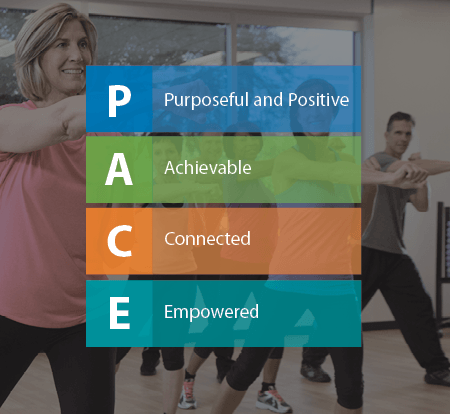
P – Purposeful and Positive
Being prepared prior to class allows you to provide more purposeful movement. You can be ready to give “on the spot” variations that provide progressions and regressions of the movements. Because you may not know if a person has hip osteoarthritis, a hip replacement, or any other condition, be prepared to offer variations for progression and variations for regression of each exercise you select.
A – Achieve
Set achievable goals at the beginning of each class, such as “work within a pain free range of motion.” Invite participants to think about their own fitness goals for range of motion, strength, or function.
C – Connect
Connect movements in class with activities of daily life, recreation, and hobbies. For participants with healthy hips, managing hip osteoarthritis, or living with a hip replacement, understanding how an exercise in class is related to or benefits a daily activity provides greater motivation to do the exercise or complete the set.
For example, “This rhythm change in our squat progression will help you have more strength and power in your hips to stand up from your chair or get in and out of your car.” Ask your class members what they like to do for recreational activities. Prepare movements that will provide flexibility, strength, and balance to improve this activity. For example, you might explain that the hamstring stretch you are doing in class will help them have better mobility in the hips to bend over and pick up their golf ball or retrieve garden tools off the ground. Good communication and cuing is the key to success.
E – Empower
Empower class participants to select the appropriate range of motion and intensity of an exercise for a self-directed workout. It is not necessary to call out a specific condition such as hip osteoarthritis or a hip replacement. When you prepare your class ahead of time, you can plan for variations of the exercise that provide both progressions and regressions, and allow each participant to make the best choice no matter any condition they may be managing. We empower our participants when we are well prepared and can offer safe guidance for exercise progression.
Safety
Providing a safe group exercise experience for SilverSneakers class participants is our number one priority. Instructors are reminded to cue the following safety skills during class:
- Perceived exertion
- Postural alignment
- Hydration
- Breathing
Identifying the benefits and risks of movement patterns and exercises will allow instructors to make better programming choices. Below are reminders of movement patterns for the lower body that have a higher risk for the general older-adult population (Reference: Foundations Lesson 3.4 Training Principles).
Safety Guideline
Definition
Risks
Recommendations
Avoid exercises that cause excessive forward flexion at the hip
Hip flexion beyond 45 degrees in a seated position and 90 degrees standing
Low back pain and injury; blood pressure decrease if head is below heart level
- Cue “bringing ribs half way to the thighs” in a seated position.
- Use a ball between the ribs and the legs in a seated position to provide a tactile cue.
Avoid jamming or locking joints or forcing joints into stretch
Forcing a joint beyond its unassisted range of motion; moving a joint in a way that compromises stability
Bone fracture; joint injury
- Perform stretches unassisted or without external force or pushing.
- Use caution when exercising on carpet.
- Use caution when teaching movements that require quick, repetitive movements or quick directional changes.
Avoid overuse
Excessive repetitions of an exercise or movement
Joint injury and muscle fatigue
- Limit resistance movements to no more than 24 variably paced repetitions of an exercise.
- Avoid excessive marching in a seated position.
- Avoid too many exercises for the same region of the body without rest.