
In this lesson you will learn how to leverage the PACE model to coach the SilverSneakers Way.
- Focus on how you can use this way of coaching to not only be effective as an instructor but also to be inclusive of all members.
- Think about the non-verbal and verbal cues you provide and the impact they have on members with vision or hearing impairment.
- Complete the 3 questions and 1 table on this lesson in the unit study guide.
The SilverSneakers Way of Coaching helps put the SilverSneakers member experience model, or PACE, into practice.
PACE stands for:
Purpose – Be purposeful about what you teach.
Achievable – Provide options to increase achievability.
Connected – Be an excellent relationship and community builder.
Empowered – Support each member in living their best life.
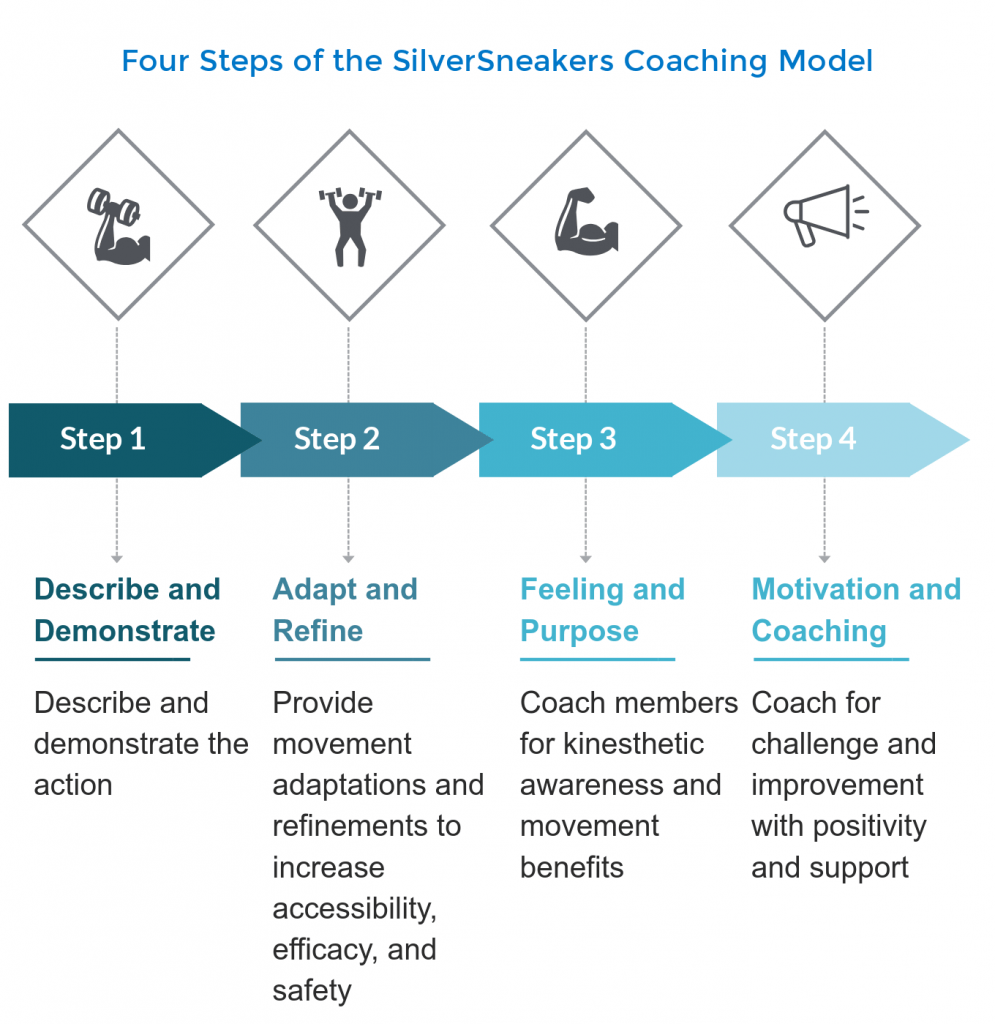
Effective coaching improves understanding and adherence while building relationships. The SilverSneakers Way of Coaching begins first with thinking about what you want to teach and how you want to teach it. Then, you move from initial delivery, to adaptation, and finally layer on feelings and motivation. Don’t forget, when you teach, your tone and language must also be considered to create a great experience.
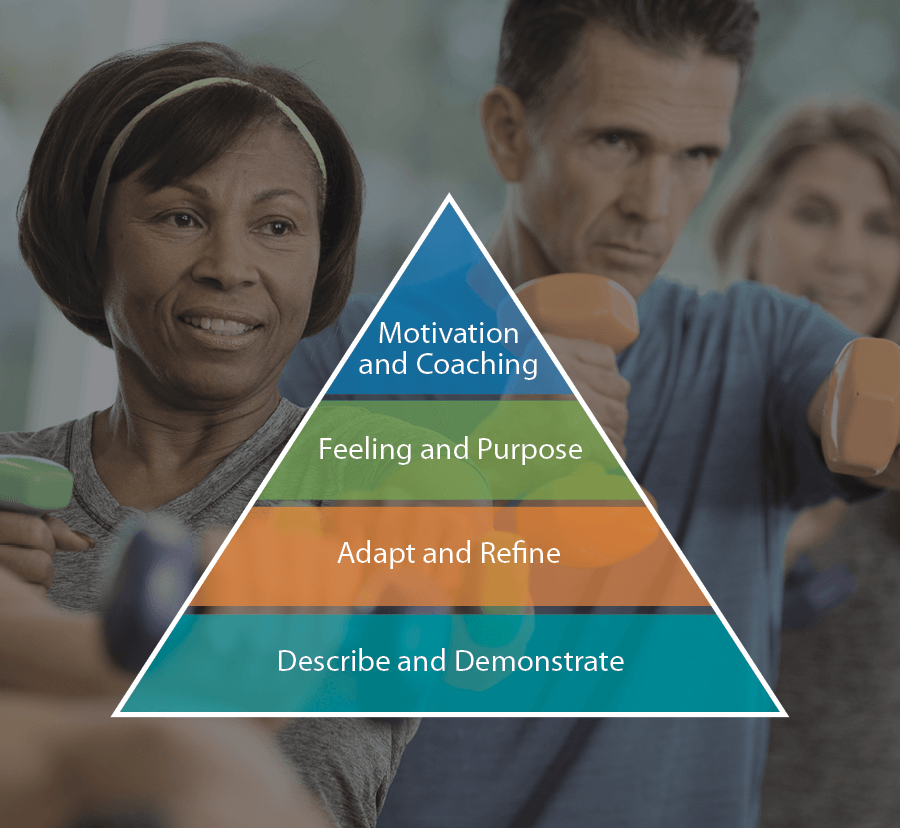
Describe and Demonstrate

STEP 1
- Name the exercise
- Provide one to three cues for safety and execution
- Describe and demonstrate the action
Example:
- Say: Squat
- Say: Feet hip width, chest lifted, abdominals engaged
- Say: Press hips back while bending the knees
STEP 2
- Utilize the correction sandwich approach for making adjustments and corrections:
- Say something positive, refine alignment or make a correction, follow-up with positive reinforcement
- Provide multiple movement adaptations, progressions and regressions
Example:
- Say: For more intensity, move hips lower
- Say: Keep thighs parallel to the floor or higher
- Say: lf there’s knee discomfort, decrease the range of motion

STEP 3
- Provide kinesthetic cues to teach participants where to focus or “feel” the exercise
- Explain the “why” behind the exercise. Include activities of daily living
Example:
- Say: Feel bodyweight pressing into your heels
- Say: Building strength and endurance in the lower body

STEP 4
- Encourage participants to challenge themselves
- Provide positive motivational cues
Example:
- Say: Just a few more!
- Say: Your form is terrific!
- Say: Feel yourself becoming stronger!
Communication and Inclusivity
As a SilverSneakers instructor, you’ll need to develop a communication style that successfully conveys your message to the participants you serve. There are certain changes commonly associated with normal aging, as well as changes that might be expected as part of an aging-related health problem such as Alzheimer’s disease, that can contribute to communication challenges in the group exercise setting. The words and tone you use to deliver your class will influence participant understanding and how your participants feel when they exercise with you. You will not only build community and relationships with members but also help members connect to each other.
Let’s take a look at factors that may impact communication in the SilverSneakers setting:
Ageism
Ageism is age-related discrimination and the tendency to regard older people as unworthy and debilitated. Avoiding ageist stereotypes and language will help create an inclusive SilverSneakers class experience. Before making broad generalizations about older adults, remember that each SilverSneakers member is a person, regardless of their age or condition.
Instructor Communication Tips for Inclusivity:
- Refer to the individual first, rather than their age. For example, a participant may be retired, but avoid calling them a “retiree.”
- Refer to the individual first, rather than their condition. For example, a participant may have diabetes, but avoid calling them “a diabetic.”
- Avoid stereotyping participants. Stereotypes may offend the populations you are attempting to reach, thus negating your message.
- Avoid slang. Current social references may confuse your audience. The more relevant your language, the more successful the communication.
- Be patient. Building relationships and trust is a process.
Hearing Impairment
The estimated prevalence of significant hearing impairment among people 65 to 75 years of age is approximately 30 to 35%; among people 75 years of age or older, the prevalence increases to 40 to 50% (Dillon, Gu, Hoffman & Ko 2010). Men are more likely than women to have a hearing impairment.
Normal age-related hearing loss, presbycusis, usually results from the cumulative effects of lifetime exposure to noise. It is focused in the high-frequency areas of the spectrum. This affects the ability to hear and distinguish certain speech sounds such as “s” and “th;” thus, speech in general sounds mumbled and unclear. People with presbycusis also have difficulty hearing high-pitched sounds. Ironically, some sounds may seem overly loud.
Instructor Communication Tips for Participants with Hearing Impairment:
- Speak slowly and clearly.
- Enunciate words and allow the lips to move freely when speaking.
- Position participants further from speakers or sound system for comfort.
- Utilize non-verbal cues or hand gestures.
- Maximize movement demonstration from a variety of positions.
- Carefully select music. Consider instrumental variations.
- Use a microphone.
Visual Impairment
Age-related changes in vision include problems reading small print, seeing in dim light, reading scrolling or other externally paced displays, and locating objects visually. Approximately one out of six Americans 70 years of age and older has impaired distance visual acuity (Dillon, Gu, Hoffman & Ko 2010).
Presbyopia is a condition in which the lens of the eye loses its ability to focus, making it difficult to see text or objects up close. Reductions in peripheral vision can limit social interaction and activity. For example, older adults may not communicate with people sitting next to them because they cannot see them well.
Instructor Tips for Working with Visual Impairment:
- Demonstrate movements from a variety of positions.
- Position participants closer to the front of the room.
- Provide an exercise mentor during large classes.
- Avoid quick movement changes and complex choreography.
- Use non-verbal cues and large hand gestures.
- Teach from a standing position.
What ways can you connect with participants on a personal level to support their individual needs?
Can you help participants connect with others in the class?