In this lesson you will learn the 5 health related and the skills related components of fitness.
- Focus on how your members benefit when your class design includes skill related and health related exercises.
- Think about specific techniques and exercises that you could include in your class to help prevent falls.
- Complete the 7 questions and 2 tables on this lesson in the unit study guide.
Health-Related Components of Fitness
Cardiovascular Endurance
Cardiovascular exercise is any mode of continuous, rhythmic activity utilizing large muscle groups, and is aerobic in nature. In addition to improving fitness level, increased physical activity is recommended for enhancing quality of life and for reducing general health risks.
With older adults, we apply aerobic training principles in a manner that discourages potential orthopedic problems and cardiovascular complications. For safety reasons, non-impact or low-impact modes of aerobic exercise are recommended. Lower- intensity, longer-duration aerobic exercise produces benefits comparable to those achieved through higher-intensity, shorter-duration exercise and may be more appropriate for previously sedentary older adults. Initially, the exerciser’s tolerance may limit duration.
Interval training is another way to improve cardiovascular endurance. Interval training is simply alternating bursts of intense activity with intervals of lighter activity. To avoid fatigue, the intensity, frequency, and duration of the intervals must match the ability and skill of the participants.
Regular aerobic activity may help reduce functional loss and chronic disease in an aging participant. The major goals of most endurance exercise programs are to improve cardiovascular, metabolic, and skeletal muscle function in the body.
Muscular Strength and Endurance
Strength training for older adults can be accomplished through various methods. Learning and mastering new strength exercise movements without the use of any resistance other than gravity and body weight is recommended for initiating strength training for low-fit exercisers. In time, these low-fit exercisers may graduate to the use of resistive exercise bands, dumbbells and strength machines.
Muscular endurance training includes a moderate to high volume of movement repetitions at a lower intensity or resistance, while strength training is targeted by performing movements that require more maximal force. Strength training generally requires heavier resistance loads. In signature classes, you’ll incorporate exercises with moderate-to-high repetitions with lighter resistance loads.
Instructor tip: Allow participants to master movements. You are encouraged to teach one set of 4 to 8 repetitions at a slow rhythm, 8 repetitions performed at tempo, followed by 8 repetitions of the movement in a modified isometric pulse, as the exercise permits. Teach up to 20-24 variably paced repetitions of an exercise. This allows for movement rehearsal, practice, and overload. Sets of exercises can be repeated throughout the class to highlight muscle balance principles while avoiding overuse.
Exercise Set Suggested Breakdown
Step
Number of Repetitions
Description
Objective
1
4-8
Slow rhythm
Movement rehearsal
2
8
At tempo
Practice
3
8
Modified isometric pulse
Overload
Flexibility
Flexibility is a joint’s ability to move through a full and normal range of motion (ROM). Flexibility can be influenced by the muscles surrounding a joint and the joint structure itself. For optimum performance, joints are both stable and mobile. However, the effects of aging and disease on joint range of movements can lead to a decrease in proficiency for performing activities for daily living. For gait improvement, fall prevention, and posture improvements, incorporate range of movement training through the shoulder and hip joints.
There are a number of ways to stretch, but not all stretches are created equal.
- Dynamic stretching is when stretching is performed in a rhythmic, yet controlled way. Since the stretches are dynamic, they are most suitable during the warm-up segment, as they promote circulation and help maintain heart rate elevation.
- Static stretching is when the stretch position is held for a longer duration. Static stretches are most beneficial for improving flexibility. Utilize static stretching during the final stretch segment of your class.
- Ballistic stretching, or performing bouncing or jerking stretches, is not recommended.
When leading a class, follow these basic flexibility programming guidelines:
During the Warm-Up and Range of Motion: Incorporate dynamic stretches. Rhythmically move the major joints of the body, starting with smaller movement ranges, progressing to fuller ranges of motion. These stretches are slow and purposeful, but keep the body moving to maximize the benefits of the warm-up.
During the Final Stretch: Perform static stretching. Time permitting, hold each position for 30-60 seconds. Longer stretches are most beneficial for flexibility improvements. The range of the stretch is gently increased in each position until mild muscular tension, but no pain is experienced.
Body Composition
While not a specific goal of SilverSneakers classes, participants may see improvements in body composition with exercise. Nutrition education is an important component of older adult exercise programming. Basic nutrition principles may be shared by instructors. Normal processes of aging and medications affect the cellular extraction of nutrients from food, thus affecting cellular absorption rates of essential vitamins and minerals. A general recommendation of multi-vitamin supplements may be appropriate for health education, however, simply reminding older adults to eat nutrient-rich foods may be the best way to encourage a healthy body composition. Water is an integral part of metabolism. For health, it is recommended that older adults consume water throughout their day and during bouts of exercise.
Skill Related Components of Fitness
Falls Prevention
Falls are the leading cause of fatal and non-fatal injuries for older Americans. Falls threaten safety and independence and generate enormous economic and personal costs. Improving functional skill-related fitness components in combination with the four health-related fitness components will minimize the risk of falling and help maintain an individual’s independent lifestyle.
According to the Centers for Disease Control and Prevention (2016):
- One-fourth of Americans aged 65+ fall each year.
- Every 11 seconds, an older adult is treated in the emergency room for a fall
- Every 19 minutes, an older adult dies from a fall.
- Falls are the leading cause of fatal injury and the most common cause of non-fatal trauma-related hospital admissions among older adults.
- Falls result in more than 2.8 million injuries treated in emergency departments annually, including over 800,000 hospitalizations and more than 27,000 deaths.
- The financial toll for older adult falls is expected to increase as the population ages and may reach $67.7 billion by 2020.
With increasing age, there is a normal decrease in sensory function, muscular strength, reaction time, flexibility and cognitive processing. Exercise programs designed with skills for fall prevention may help build strength and confidence while reducing the risk for a fall. Therefore, each SilverSneakers signature class includes skill drills for fall prevention.
There are five skill-related components of fitness: balance, power, speed, agility and coordination. Each skill area plays an important role in improving functional performance. Teach drills to improve the five skill-related components of fitness in each signature class. To help remember these skills, use the acronym “ABCS-Please”.
A – Agility
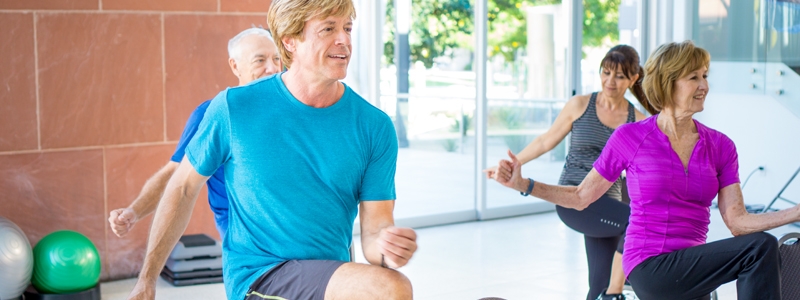
Include drills or choreography that require shifting weight from one foot to the other while moving side to side and forward and back.
Being agile helps regain and maintain balance. Some drills include:
- Walk in a circle. Change directions
- Walk forward and backward
- Cha cha right and left.
- “Rocking horse” – forward and back
- “Pendulum swing” – side to side
- Two steps right, one side step left, one side step right. Repeat left
- Out-out-in-in, right foot lead, Out-out-in-in, left foot lead
B – Balance
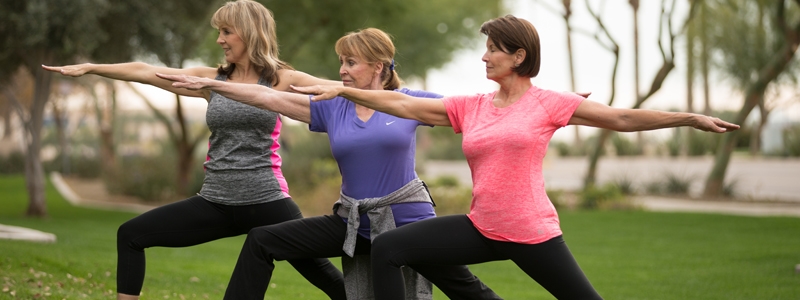
Sustaining good postural control depends on a person’s ability to rely on three centers for adaptability:
- the vestibular system (located in the inner ear),
- the musculoskeletal system’s response to center of gravity changes, and
- the neuromuscular sensory system’s response to surface variations.
These three systems are dependent on vision and the body’s ability to maintain good head stability in space. Without vision, the body primarily depends on the vestibular system. Medication may also affect an individual’s ability to balance.
Static balance drills are stationary. The ability to respond to changes in stability requires training for dynamic balance and helps prevent falls.
Challenge your participants’ balance with exercises like:
- Seated balance: Hold one hip off the chair, with hands up – arms unsupported.
- Seated balance: With the ball placed on the floor, left foot is placed on top of the ball, hands on hips; raise the right foot off the floor. Switch feet.
From a seated position with both knees and feet together, hands placed across the chest, stand up and sit down in the chair. Repeat with eyes closed.
- Standing sagittal balance: Leg lifted in front or in back of the body.
- Standing frontal balance: Leg abducted to the side of the body.
- Stand with your eyes closed.
- Stand on your toes with one hand on the chair and reach your other hand upward (as if reaching for a top shelf). Switch hands.
- Stand on your toes (one foot in front of the other) for a tightrope balance.
C – Coordination
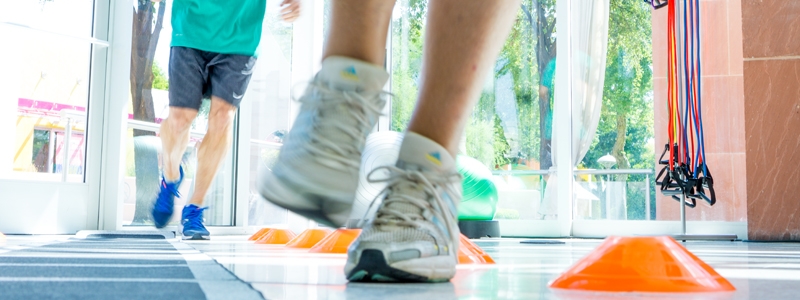
Coordination is neuro-physiological fitness. As coordination deteriorates, risk for falls may increase. Movements that cross the midline of the body, movements that require one action from the left side and another action on the right side, as well as complex movement patterns, improve coordination. These drills can be fun and challenging:
- Right hand to lifted left knee. Left hand to lifted right knee
- Kick right leg, lift left arm. Kick left leg, lift right arm
- Heel taps to the front, arms push out to the side
- Right heel front, left toe side. Left heel front, right toe side
S – Speed/Reaction Time
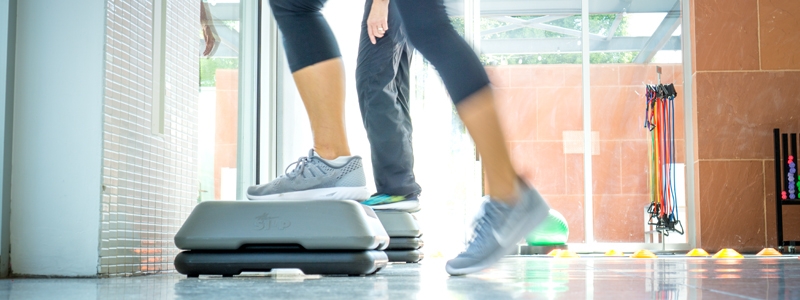
A fall is not a slow-motion action. Teach drills to address response time to sudden acceleration and deceleration of movement. Change pace by working to the baseline, half-time and double-time beats in your music. Speed drills include:
- March to tempo. March half-time. Stampede!
- “Fast feet” stop ‘n go: Reaction time for driving a car.
- “Simon says:” Responding to a variety of verbal cues.
- Rehearse an exercise movement at half-time tempo, continue with an at-tempo speed, and finish the set at a double-time tempo.
P – Power
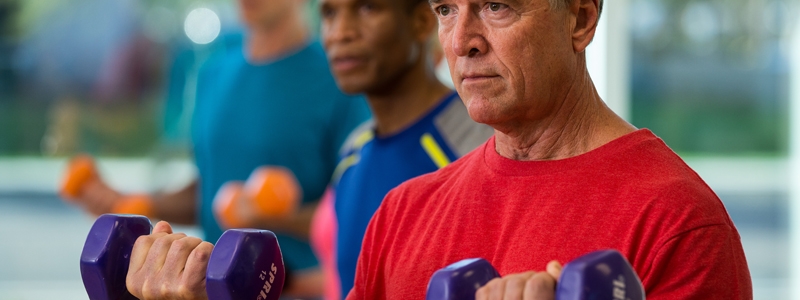
Lower body muscles are needed for stability actions that require fast, powerful movement to avoid falling. Acceleration is a component of true power movements. Exercises include:
- “Stand up, sit down:” Getting in and out of a chair, bed or car.
- Stand up and slowly sit down (Eccentric: up 1, down 3).
- Lower the body slowly to sit and then stand up quickly.
- With elastic tubing with handles: From a seated position, handles in each hand and tubing under both feet, stand up and sit down.
Performing skill-related drills can be challenging, particularly for a new participant. Keep drills simple and fun. Provide intensity options so each participant leaves class with a feeling of achievement. Since training for fall prevention is incorporated into each signature class, you’ll receive additional exercise ideas during each format training.
Cognitive Health
Cognitive health is an additional component SilverSneakers instructors are encouraged to understand and include. Cognitive health is a major factor in ensuring quality of life and preserving the independence of our members.
Cognitive health can be targeted a number of ways. According to the National Institute on Aging, cognitive health is the ability to clearly think, learn, and remember (2017). As we move from childhood to adulthood, the complexity of our brain activity increases, boosting our capacity to process information. This complexity then starts to reduce in healthy older adults.
The Journal of Cognitive Neuroscience found that older adults who were physically active had a unique pattern of brain signal complexity, showing greater local processing of information than both younger adults and their less-active peers (Heisz, Gold & Mcintosh 2015). The results suggest that exercise helps to improve information processing and cognition. In addition, exercise may be a “magic bullet” for combating common neurological diseases.
Instructor tips for cognitive health:
- Teach participants movement patterns in a way that encourages learning. Break movements down into their simplest form, then allow for additional progressions to test memory and improve neuromuscular functions.
- Encourage cardiovascular activity. University of British Columbia researchers found that regular aerobic exercise boosts the size of the hippocampus, the brain area involved in verbal memory and learning (Brinke, Bolandzadeh & Nagamatsu, 2014).
- Teach exercise to improve coordination. Complex exercises, as well as movements that cross the midline of the body, improve neurophysiological fitness.
- Remember your relaxation segment! Research indicates that meditation and stress reduction techniques can increase attention span, sharpen focus and improve memory. (Hölzel, Carmody, Vangel, Congleton, Yerramsetti & Lazar 2011). Incorporate breathing, imagery and relaxation techniques into each signature class.