
In this lesson you will learn about the SilverSneakers Signature Class Format.
- Focus on how you can best integrate the SilverSneakers class components within the class formats you teach.
- Think about how members benefit from the 5 unique class segments you design and incorporate into the class.
- Answer the 6 questions on this lesson in the unit study guide.
Designing and leading safe and effective group exercise classes is the primary role of the group exercise instructor. This unit provides information about class segment design and exercise selection.
SilverSneakers offers group exercise programming to meet the needs of a diverse membership while targeting a variety of health- and skill-related components of fitness. Each signature class is an engaging experience that follows a five-segment format, includes choreography that is both safe and challenging while utilizing the group setting to improve functional skills, cognition, and social support. Classes use music to enhance motivation, while instructors lead a multi-level exercise experience highlighting functional movement patterns, chronic disease management and skills for fall prevention.
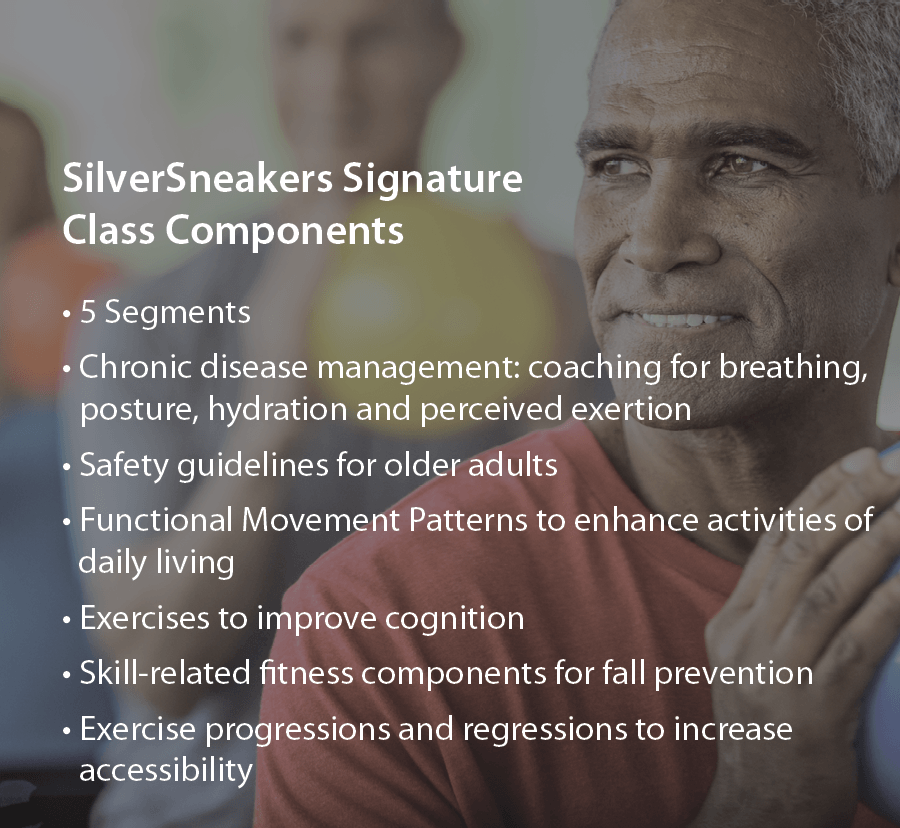
Here are the five segments of a SilverSneakers signature class:
Segment 1: Warm-Up and Range of Motion
- To increase circulation to the extremities and elevate core temperature
- To prepare major muscles and joints of the body for conditioning
- Warm up large muscles first
- Introduce class goals and provide information about the structure of the workout
- Initiate dynamic range of movements and stretches through the two-ball and socket joints (hips and shoulders), followed by joints with lesser mobility (neck, elbows, ankles, wrists, and fingers) to prepare the major joints of the body for conditioning
- Ball and socket joints of the hips and shoulders are involved in most exercises. Allow for an adequate warm-up for these two joints.
- Rehearse movements that will be used later in the work phase
- Use lever progression for both the upper and lower body
- Avoid using weighted resistance tools in the warm-up
Segment 2: Work
- To improve health-and skill-related components of fitness as determined by the goals of the class format
- Teach intensity options and concepts to accommodate a wide variety of skill levels
- Provide progression and regression options for most exercises
- Program functional movement patterns while highlighting skills and drills
- Employ the principle of overload to maximize improvement
- Follow muscle balance principles to ensure a total-body conditioning workout
Segment 3: Cool-Down
- Promotes venous return
- Restores normal circulation pattern
- Prepares participants for final stretch
- Perform movements at a slower pace
- Incorporate additional options for balance, coordination, agility and core conditioning
- Avoid using weighted resistance tools in the cool-down
Segment 4: Final Stretch
- The final stretch promotes flexibility in major and minor joints of the body
- Encourage participants to exercise in a pain-free range of motion
- Lead a total-body static stretch
- Select stretches that target the two ball-and-socket joints of the hips and shoulders for optimal posture and mobility improvement
- Provide external support as needed to allow for deeper stretching
- Choose to perform the final stretch in a standing or floor-based position based on individual class format requirements
- If adapting stretches to the floor in approved formats, transition carefully: Lower one knee, then the opposite arm. Follow by lowering the other arm and knee.
- Hold stretches for 30-60 seconds. Longer stretches have greater flexibility benefits
- Avoid forcing stretches beyond normal-unassisted range of motion
- Long exhalations help to decrease residual volume air and increase tidal volume and chest wall elasticity.
Segment 5: Relaxation
- Improves sense of well-being
- Reduces stress
- Choose from a variety of relaxation techniques
- Affirmations
- Visualization
- Imagery
- Physical relaxation
- Hold stretches for 30-60 seconds. Longer stretches have greater flexibility benefits
- Avoid forcing stretches beyond normal-unassisted range of motion
- Long exhalations help to decrease residual volume air and increase tidal volume and chest wall elasticity
Visualize in your mind the five segments of the class and the impact that each of these concepts has on your members.
Format exceptions:
- In our signature mind-body formats such as Yoga and BOOM MIND, the warm-up includes three sections, Centering, Breathing and Movement.
- If teaching Splash, you will use your “cool-down” to help transition participants to the final stretch. Cooler water temperatures may require you to keep your class moving so they do not get cold during this segment of the class.
- A traditional cool-down may not be needed in our signature mind-body formats such as Yoga and BOOM MIND. Instead, use this segment to transition to the final stretch.