As an EnerChi instructor, you can introduce and teach additional tai chi forms and qigong exercises. Follow SilverSneakers safety guidelines when introducing new forms. Instructors are responsible for making risk vs. benefit exercise decisions in exercise selection.
EnerChi follows the principles found in Yang and Sun styles of tai chi practice, with emphasis on higher, upright postures and slow, gentle movement. The more vigorous forms as practiced in the Chen style would not be appropriate for SilverSneakers EnerChi.
Reminders of higher risk movement that need modification are listed below:
Adjust forms to flow forward and backward or side to side. Avoid twining or spiraling steps (interlacing of steps, as this may cause a tripping hazard).
Be mindful of how the forms will flow from a standing position. Watch that the chair does not become a tripping hazard.
Modify forms to minimize excessive spinal flexion or extension in seated and standing practice.
Adjust forms or stances that incorporate deep knee bending.
Below are examples of tai chi forms that require modification to meet SilverSneakers safety guidelines.
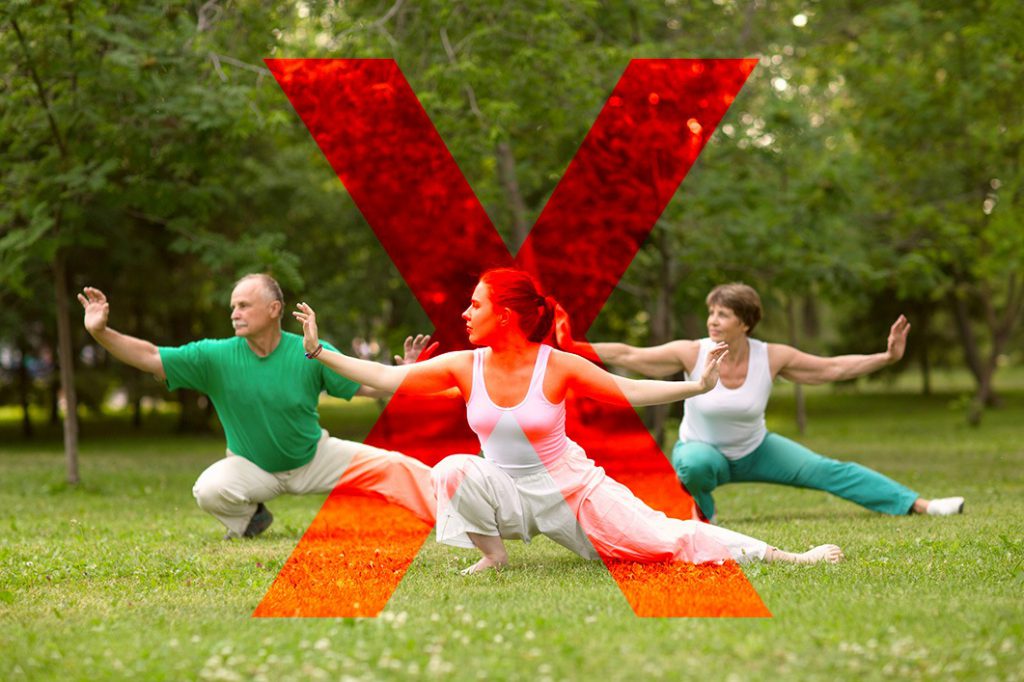
Tiger stance or “squatting stance” is an extreme stance that teaches deep knee bending. If choosing to teach forms that use this stance, modify as a higher and narrower stance.
“Snake Creeps Down and Golden Pheasant Stands on One Leg” are examples that use the Tiger stance. Teach these forms with a higher stance.
Forms that require deep bending and squatting should be avoided in SilverSneakers EnerChi. Avoid using forms like the one pictured here or teach them with a higher stance.
“Repulse the Monkey” uses backward walking, generally repeated four times. Because of the increased risk of falling with extended backward walking, the distance members move away from their chair, and the risk of tripping over other chairs or objects in the room, this form should be modified to reduce backward stepping. A recommended modification would be to use a variation of Horse stance and focus on flowing the upper body movement with lower body weight shifting.
“Touch the Sea, Look at the Sky” incorporates deeper flexion and extension of the spine. Minimize the movement to go no more than 45-degree forward flexion at the hip from a seated position or 90-degree forward flexion at the hip from a standing position. Maintain head above heart.
If forms using “Kicks” are introduced, teach a base position that all participants can safely practice with good posture and balance, such as a half step with empty stance. From there, progress to a knee lift before advancing to a kick.
Be sure you understand the form or exercise technique well before teaching to class participants. Many forms have several steps or actions that are important to achieving the beneficial end result. Understand how to apply tai chi principles to the form and layer in with practice.