
In this section, we will cover a few important reminders as you teach your SilverSneakers classes and incorporate your brain training exercises.
First, we want to mention that cognitive exercises or drills should not be too complicated or challenging for your class members. Follow the 80/20 principle, ensuring that members are 80 percent proficient with any physical movement you introduce before layering on a cognitive challenge. Additionally, try not to include new choreography and brain training on the same day.
Introduce cognitive drills and challenges to your members based on skill level. If drills are too challenging, members may be frustrated and anxious, and if drills are too easy, they may get bored, see figure 1. Selecting the right level of challenge might require a little trial and error.
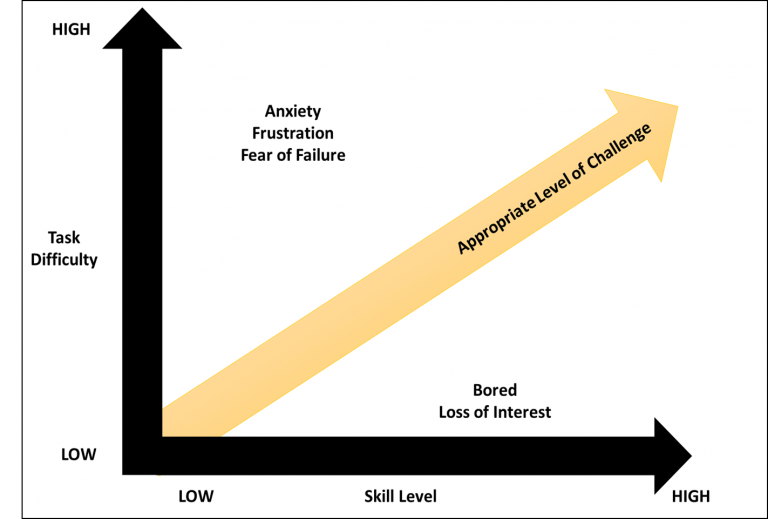
Members often want to know what it means if they don’t succeed at a cognitive drill or they can’t keep up or perform it, worrying that they may suffer from poor brain health. Of course, this is not usually the case. It is important to emphasize while teaching SilverSneakers classes that each of us need time and practice to learn a new skill.
Exercise progressions and regressions
To successfully teach a multilevel class and meet the fitness goals of each participant, instructors should be knowledgeable with exercise variations that provide progressions and regressions.
A progression adds complexity, difficulty, or intensity to an exercise, while a regression decreases the complexity, difficulty, or intensity of an exercise.
Progressions and regressions should be used in all SilverSneakers classes you teach. These principles should, likewise, be applied to the cognitive drills and training you layer into your class.
Samples Below
Progression
- Alternating knee lifts – Physical movement – Skill 1
- Add another physical movement – Alternating arm raises – Skill 1 + 2
- Add cognitive skill – Serial three subtraction – Skill 1 + Skill 2 + Skill 3
Regression
- Alternating knee lifts – Physical movement – Skill 1
- Add cognitive skill – Serial three subtraction – Skill 1 + Skill 2 + Skill 3
Note: for a regression, one physical movement and one cognitive challenge may be enough for your participants.
Progression
- Step touch – Physical movement – Skill 1
- Add another physical movement – lateral arm raises– Skill 1 + 2
- Add cognitive skill – alphabet backwards – Skill 1 + Skill 2 + Skill 3
Regression
- Step touch – Physical movement – Skill 1
- Add cognitive skill – Serial three subtraction – Skill 1 + Skill 2 + Skill 3