
In this lesson you will learn about the best practices to provide a safe and fun experience for Classic participants.
- Focus on how these best practices enhance your class leadership.
- Think about how you can work to further develop these leadership practices over time to benefit your class participants.
This section includes a review and summary of teaching tips and best practices. Learn and use these best practices to achieve optimal results for your students as well as to become an exemplary SilverSneakers instructor.
Intensity Variations – Regressions and Progressions
Providing a variety of intensity options, regressions and progressions for exercise, increases both the safety and the effectiveness of each selected exercise. Progressions and regressions allow each class to meet the needs of a wide variety of individuals, all of whom have differing skill and fitness levels.
Get to know your members and have a plan for each class you teach. When developing a class plan, be sure to utilize fitness variables to progress and modify each exercise for your participants.
In Classic, participants have the option of using a chair for seated or standing support. Be ready to adapt your exercises to both positions so that more fit and able-bodied members can perform the movement standing, while other class members who may be less active and fit can still participate and have a meaningful and challenging class experience.
Standing and seated options – Encourage participants to remain standing as much as possible in order to create a functional challenge. Give your participants at least three opportunities to stand during a Classic class.
There are no floor options in SilverSneakers Classic. Movement may be performed from either a seated or standing position.
Explore squat options – Seated, standing in front of chair, behind chair. Hug all the muscles below the belt as though you are going to stand up and out of the chair, while you stay seated. This way, the standing member can perform squats and the seated member can perform a squat adaptation.
Range of motion – Increasing range of motion, or encouraging more movement at a joint, can increase exercise intensity. An option for smaller range of motion during an exercise will decrease work load.
A squat, can be performed with less range of motion, or depth through the knees. For more intensity, encourage participants to sit the hips back further, bending the knees a little bit more. Provide options.
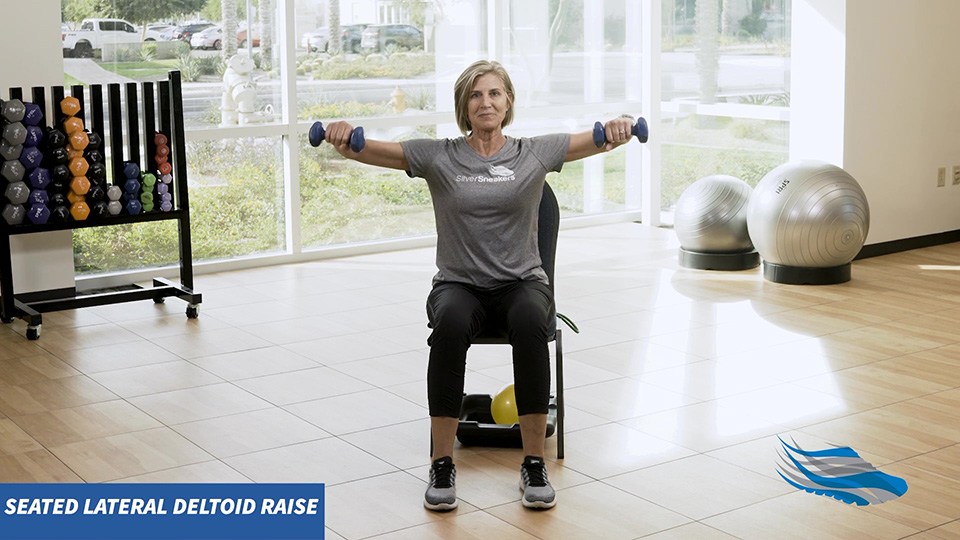
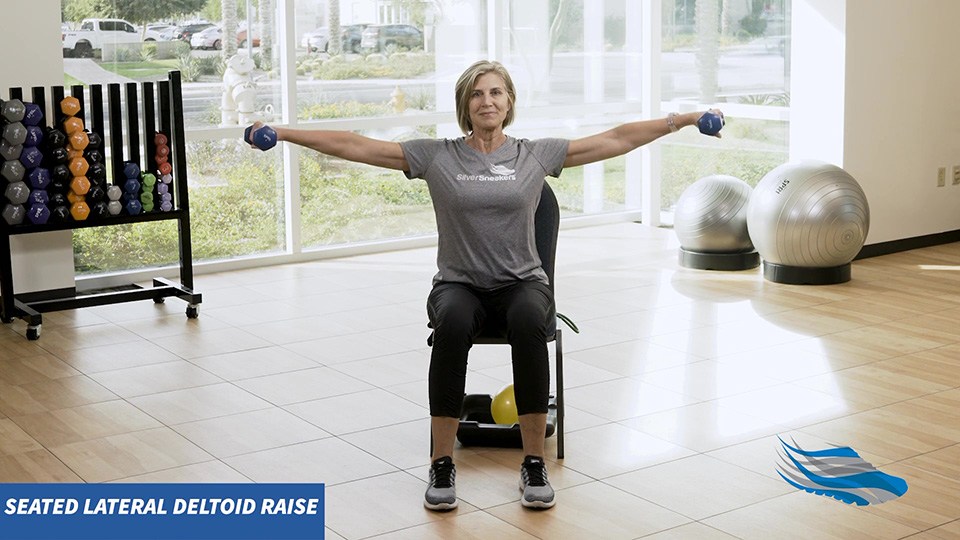
Lever length – Using a longer lever requires more strength than using a shorter lever.
Lever length as it relates to Lateral deltoid raise: Perform lateral deltoid raise with a bent elbow, compared to a lateral deltoid raise with a straight arm. The straight-armed version is more intense.
Short lever:
Long lever:
Balance variations – Balance requires the coordination of several systems in the body, including the vestibular, somatosensory and visual systems. Be sure to offer balance options in all planes of the body: sagittal, frontal and transverse. Also, consider movement options that include both dynamic and static balance challenges.
To improve balance, a simple lateral raise might become a lateral raise with lateral leg raise.
Mirroring
Classic instructors should teach from the front of class, facing the participants from a standing position, as much as possible, to offer participants optimal visibility and to increase motivation. As a Classic instructor, be sure to utilize mirror image cueing. In mirror image cueing, the instructor effectively becomes a “mirror” for class participants. Practically speaking, this means that the instructor performs movement in opposition to class members. When movement is cued to be performed by students on the right side, the instructor is performing the same movement on his or her left side. While this practice may be challenging at first, it is the most intuitive and safe way to teach a SilverSneakers Classic class.
Creating Smooth Transitions – Entry, Action, Exit (EAE)
To create a safe and efficient class, it is important that smooth transitions are incorporated into the class design and programming. In order to create smooth transitions, we can employ the Entry, Action, Exit method, or EAE. When practicing EAE, we create a defined start and end point for each exercise and for each repetition of any given exercise.
- Entry – Tell your class participants where the movement begins and cue them how to get to the start point correctly.
- Action – Tell your participants how to execute the movement with good form. What should they be doing during the exercise?
- Exit – Tell class members how to end the movement and where to go next.
Instructor tip: In a smooth transition, the exit point for one movement becomes the entrance point for the next movement.
Design Movement with the Five Skill-related Fitness Components in Mind
- Agility – Add movement that require weight shift, performing these agility exercises in the sagittal plane (shifting forward and back) as well as the frontal plane (side to side). For example, during warm up include rocker steps forward and step- touch movements side to side.
- Balance – Practice both static and dynamic balance in all planes of the body: sagittal, frontal and transverse. This type of programming will provide your class members with the best opportunity to improve balance and stability.
- Coordination – Coordination drills can bring fun and laughter to your Classic class. You can program exercises that require coordination throughout your Classic class. For example, try a biceps curl with the right arm, while performing a front raise with the left arm. After completing your set, perform the movement on the opposite side.
- Power – The lower body performs as the base for all standing movement. If the base is weak, then the entire body suffers. In Classic, we emphasize lower body power and strength. A strong lower body and core are extremely important in regard to preventing falls and maintaining independence and mobility. Train your class with function movements that strengthen the power center of the body: squat variations, inner thigh ball squeezes, lunging movements, etc.
- Speed and Rhythm Variation – Life happens at many different speeds, so be sure to offer speed and rhythm variations during your Classic class. Moving at a variety of speeds can be an effective way to train for fall prevention skills. Try moving at half-time (two beats per movement), tempo (one beat per movement) and double time (two movements per beat) when it is safe to do so. Uneven rhythm variations, like single-single-double knee lifts, or cha-cha-cha triplet-style movements are extremely beneficial for older adults.
Music
Music can provide structure and a motivational “lift” to your Classic class. Use pre-formatted music, appropriate for group exercise, with a consistent beat and tempo. The recommended tempo for Classic is 124 – 128 beats per minute (BPM). Use music to keep participants moving together by incorporating music identity skills. Most music that is produced for use in exercise classes, with the exception of music produced for mind/body formats, is divided into 8-count and 32-count phrasing. Practice movement following both the 8 and 32 count phrasing for the best results in class participation.
We’ve partnered with Yes! Fitness Music to provide this music and created a free album just for you that is available through the Yes!GO Music app. In addition, as a SilverSneakers instructor you can receive a discount on all Yes! Fitness music.
- Access your free playlist here: www.getyesgo.com/silvermix
- Redeem your discount on all other great music available from Yes! Fitness Music here: www.getyesgo.com/silver