
In this lesson you will learn about how to follow the SilverSneakers Way of Coaching to provide the best fitness leadership to your Classic participants.
- Focus on how your coaching strategies align with the Silversneakers Way of Coaching.
- Think about how you can use the Silversneakers Way of Coaching to increase engagement and motivation in your classes.
The WAY you teach is just as important as WHAT you teach.
The SilverSneakers way of coaching helps create the culture of your class.
Effective coaching improves understanding, increases motivation and creates proper form and alignment while building relationships. The SilverSneakers Way of Coaching begins first with planning and strategizing what you want to teach, while keeping in mind how you want to teach it. When you move from initial delivery to adaptation for individual participants, more specific communication and motivational feedback can be layered into your class presentation. Always be mindful when teaching that your tone and language choices are crucial elements of creating a successful, positive and nurturing Classic class experience.
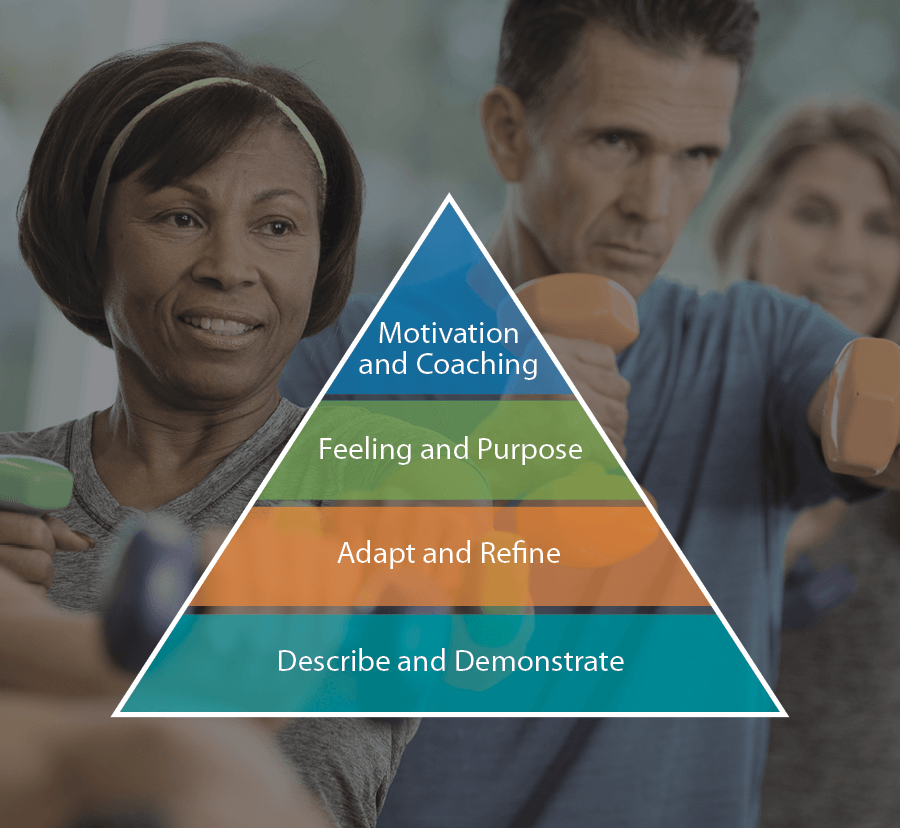
Let’s explore a functional movement pattern that is commonly practiced in Classic and apply the SilverSneakers Way of Coaching to two versions of a squat. Our first movement begins from a standing position, while our second exercise starts seated in the chair.
Describe and demonstrate
Name the exercise. Then provide one to three cues that communicate and define safety and execution.
From a standing position:
- “Let’s squat!”
- “Sit the hips back, keeping your weight centered in the front of the heel with knees behind the toes.
- Squeezing the muscles in your thighs as you stand tall, be sure to keep the knees slightly bent as you come to standing; core and gluteals engaged.
From a seated position:
- “Scoot forward, toward the front of the chair, and get ready for a chair squat.”
- “Placing the feet about hip distance apart, begin to press the feet into the floor until you feel the thighs start to engage.”
- “With hands on your thighs, draw the belly button in to firm your abdominals. You can remain in your chair with your thigh muscles engaged or go ahead and press up to a standing position.”
- “Those who are seated can relax the contraction. If you are standing, make sure your chair is close by and then come back to a seated position.”
Adapt and refine
Provide adaptations and options to increase accessibility, efficacy and safety. It can be helpful to use the “correction sandwich”. To practice this method of communication, begin by giving positive feedback. Continue by making a refinement, adjustment or correction. The final piece of the correction sandwich is positive reinforcement. Be sure to provide multiple movement adaptations, refinements, progressions and regressions, whenever possible, for the exercises you teach.
From a standing or seated position:
- “Great job! You are looking good.”
- “Make sure to keep the abdominals tight and the chest up, lengthening the spine.”
- “Move only in your pain-free range of motion.”
- “You look strong!”
Feeling and purpose
Describe the purpose and benefit of the exercise you have chosen to teach. Be sure to provide kinesthetic cues, making sure participants understand how a movement should feel and exactly what they should be doing as they perform the movement. Explain the purpose and muscle focus behind the exercise selection, being purposeful as you include activities for daily living (ADLs).
From a standing position:
- “Feel your bodyweight pressing into your heels, building strength and endurance in the lower body.”
- “Pretend you are getting up from your seat at the movie theater. As you stand tall, squeeze the muscles in the back side of your body.”
From a seated position:
- “Feel all the muscles in you lower body as you push the feet into the floor.”
- “If you choose to come out of the chair, focus on squeezing the gluteals as you stand tall.”
- “We become stronger as we practice these seated or standing squats, which will make it easier to get up from our chairs.”
Motivation and coaching
Coach for challenge and improvement with positivity and support. Be a motivator, making the Classic experience challenging, purposeful and fun!
- “Just a few more!”
- “Your form is terrific!”
- “Feel yourself becoming stronger.”
- “You are strong; you are motivated, and you can do this!”