
In this lesson you will learn about SilverSneakers Classic class design principles.
- Focus on how SilverSneakers Classic applies the signature 5-segment class design.
- Think about how each segment benefits members of varying fitness levels.
SilverSneakers Classic 5-Segment Design
SilverSneakers Classic is a 45- to 60-minute class and uses the signature 5-segment class format. This structure forms the framework to help you teach thoughtful, effective and fun SilverSneakers Classic classes.
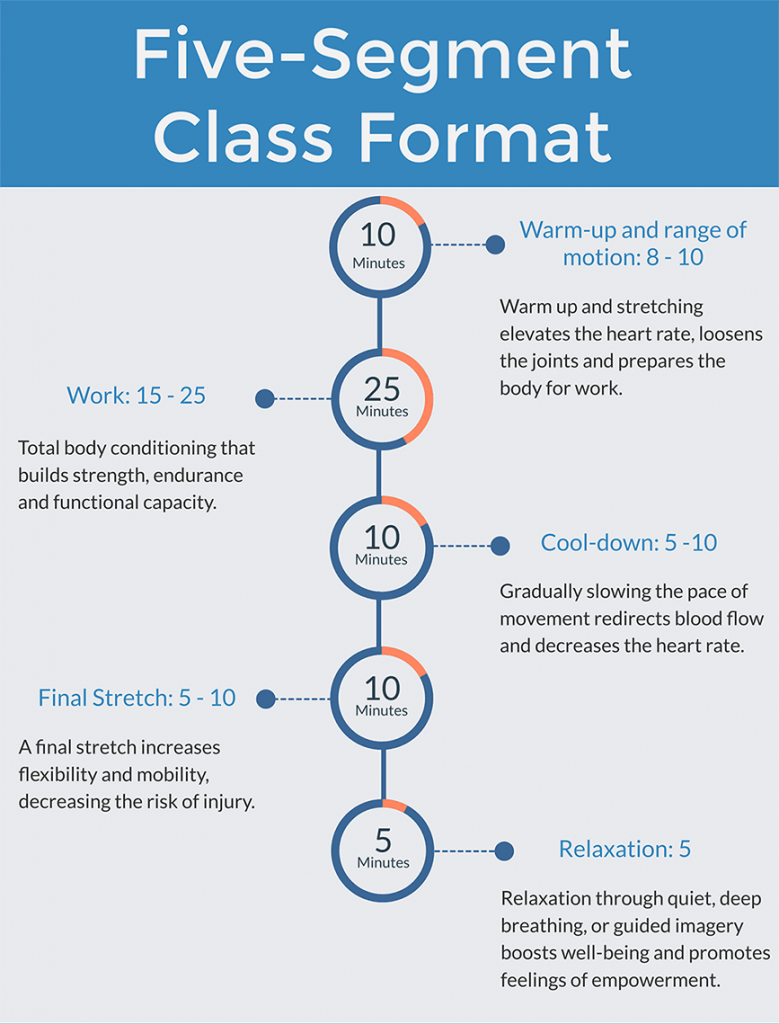
Warm-up and Range of Motion – 8 to 10 minutes
The warm-up and range of motion stretching segment prepares the body for work. It elevates the heart rate and gets the joints ready for resistance training. Be sure to teach dynamic movements that utilize large joints and muscle groups before moving to smaller joints and muscles. Avoid lifting the arms over the head at the start of the warm up segment. Instead, wait until the shoulders are fully warmed up before lifting them overhead. Additionally, avoid starting the warm up with a movement like toe taps.
Warm up and range of motion tips:
- Try teaching the warm-up with participants in a standing position. Standing work increases challenge and it helps train for independence.
- Use the SilverSneakers ball. Perform large, rhythmic movements.
- Taking the time to observe your class members during the warm-up can provide you with important information:
- Are they moving and balancing well?
- Is there anything that stands out as being different or out of the ordinary?
- Use the warm up to rehearse movements that participants will see in the work phase of class.
- Test for agility and balance with dynamic skill drills.
Work – Muscular Strength and Endurance – 15 to 25 minutes
The exercise we do in the work segment in our Classic class facilitates improvements in muscular strength and endurance and practical functional capacities. In this class format you’ll use our three signature tools to create a total-body conditioning class. The work phase in Classic focuses on strength and mobility.
- The resistance tools used in Classic are designed for progressive overload. Resistance tools are used to challenge endurance and strength.
- Encourage participants to work at a resistance level where exercises can be performed both safely and effectively. There must be enough resistance to create muscular challenge, but the challenge should be such that movement can be performed with low risk of injury.
- Participants are not required to use the tools, and the use of equipment should not compromise form in any way.
- Remember the 2:1 principle. This guideline states that greater effort (two times the effort) and work should be performed on the weaker body parts than the stronger ones. Select exercises that strengthen the muscles that are commonly weaker and overstretched, such as the upper back or anterior tibialis.
- Smooth transitions are the key to safety. Keeping your class exercise programming moving with easy and safe transitions will benefit your class members by providing a small aerobic training benefit during your Classic classes.
Cool-Down – 5 to 10 minutes
A well-developed and complete cool-down redirects blood flow and decreases heart rate. Be sure to keep your participants moving during the cool-down, but movement should be performed at a slower pace or lower intensity. The cool-down can be performed entirely in a standing position with seated options, in a seated position, or it can begin with standing movement, transitioning to a seated position later in the segment. The cool-down is a great time to incorporate coordination drills.
Final Stretch – 5 to 10 minutes
The final stretch segment targets flexibility and mobility. A chair is used as an anchor to facilitate deeper stretches.
Tips for Final Stretch:
- In the final stretch segment, hold stretches for 30 to 60 seconds.
- Stretch large muscles and joints of the body, but don’t forget about the wrist, ankles, fingers and toes.
- The hips and the shoulders are the most critical joint in relation to mobility and posture. A lack of flexibility and mobility in the hips and shoulders can even contribute to fall risk for older adults.
- To help reinforce good posture, target the strong, tight muscles with flexibility exercises. Remember the 2:1 Principle. This principle applies not only to strength training, but also to stretching. Stretch the muscles that are typically tight, like chest, anterior deltoid and hip flexors, twice as long as you stretch the muscles in the body that are less tight.
Relaxation – 5 minutes
The relaxation segment boosts well-being. Just a few minutes of quiet time, deep breathing, or guided imagery will help Classic participants feel empowered and refreshed. Choose relaxation techniques that best fit your style and personality.
Relaxation examples:
Guided imagery – Take your students on a “virtual” trip to anywhere in the world
Inspiration – Read a short inspiring poem or quote from your favorite author
Breathe – Practice some relaxing breathing techniques like abdomino-thoracic (belly) breathing or alternate nostril breathing
Contract/Relax – Have students progressively engage muscles from toes to head, squeezing the eyes closed without clenching the jaw, for the length of an inhale; then, exhale all stress and tension away from the body. This practice can be repeated 2 to 3 times, if desired
Instructor tip: In respect of the faith and religious background of each class member, and in the spirit of inclusivity, avoid conducting the relaxation with a religious theme.