Taking the time to read food labels can help individuals make better food choices. Food labels can be found on processed foods and drinks, on cans, boxes, bottles, jars and bags. Nutrition labels provide information about ingredients, nutrients and food safety.
Product dates provide information to help guide understanding of freshness and safety of food products. There are three types of product dates used on food products:
- “Sell by” – states how long the store can sell foods like meat, poultry, eggs or milk products. These products should be purchased before the stated date.
- “Use by” – informs how long the food will be at peak quality. Some foods may no longer be safe to consume after this date.
- “Best if used by” or “best if used before” – explains how long the food has the best flavor or quality. It is not a purchase or safety date.
Ingredient lists inform the consumer on everything that a processed food contains. Ingredients are presented in the order of largest amount to smallest amount. This means there is more of the first ingredient listed on the label than any other ingredient. The last ingredient on the list is found in the smallest amount.
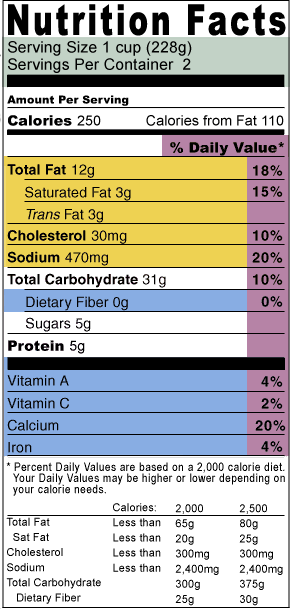
The Nutrition Facts label is required by the U.S. Food and Drug Administration (FDA) on all processed food such as breads, cereals, canned and frozen foods, snacks, desserts and drinks. Nutrition information for fresh fruits, vegetables and fish is voluntary. Individuals who would like information on these products can go to the United States Department of Agriculture (USDA) Food Composition Database.
The Nutrition Facts label is all white with black letters. More information on nutrition labels can be found on the FDA’s website. Search “labeling and nutrition”. Select “Nutrition Facts Label Programs and Materials”.
The top of the label provides the definition of a serving of the food or drink and the number of servings in the container. The nutrition information that follows is for one serving, not for the whole package or bottle. If a package contains two servings and the entire package is consumed, the numbers on the nutrition label are doubled. This means twice the calories, twice the fat, twice the protein and so on.
Daily Value (DV) is how much of each nutrient most people need each day. The % DV says what part (as a percentage) of the total daily recommendation for a nutrient is in a serving. The Daily Value is based on eating 2,000 calories each day. Caloric needs vary based on gender, activity level and age.
Nutrition Label Tip
If a food has 5 percent of the Daily Value or less, it is low in that nutrient. If it has 20 percent or more, it is high in that nutrient. Low or high can be either good or bad. It depends on whether an individual needs more of a nutrient, like fiber, or less, like sugar.
Instructor tip: SilverSneakers instructors can print and share tips on learning to understand nutritional labels from the FDA’s website “Nutrition Facts Label Programs and Materials.” Consider having a social event to learn more about nutrition labels. Ask everyone to bring in their favorite snack and drink. Set the snacks out on a table with the nutrition label by each item. Provide a brief presentation teaching how to read nutrition labels and ingredient lists, then invite participants to read the labels on their favorite products. Discuss if these are healthy choices and what might be changed or substituted to make a better choice.
Member Experience
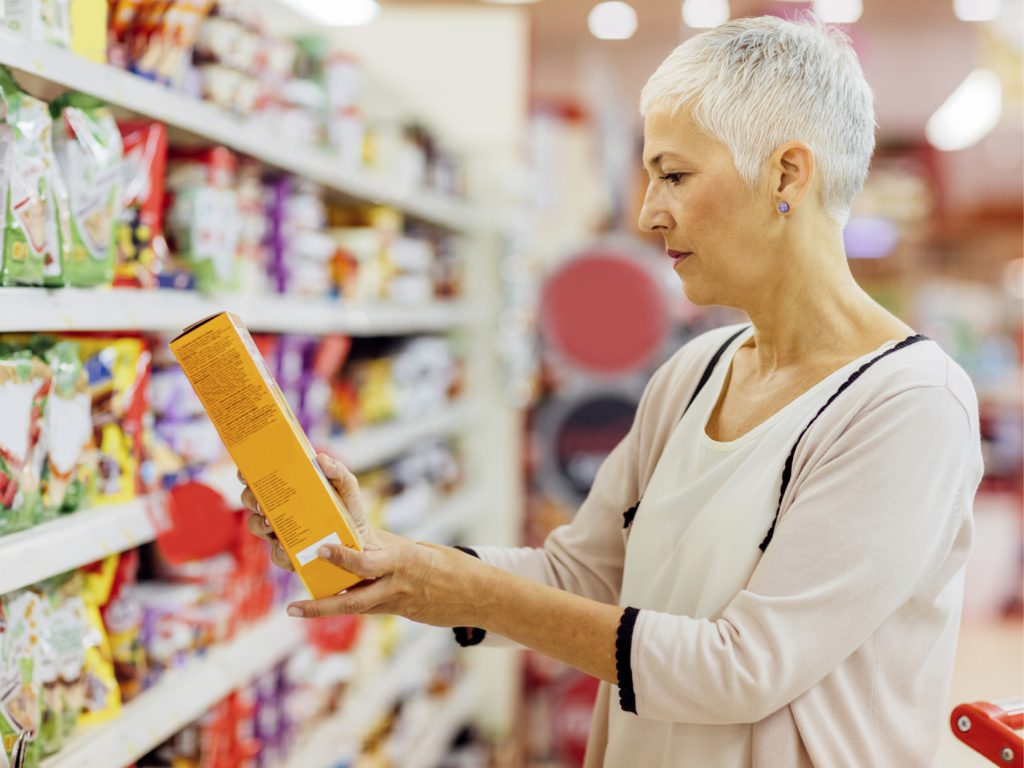
“Thanks to the help of my instructor to learn to pay more attention to the nutrition label, I’m reading the labels on everything lately. I picked this up thinking it would be a good snack to keep in the car in case of emergency snack attacks. Wow! Look at the sugars and other ingredients listed here! Trying to eat as unprocessed as possible, this will NOT be included!”