Warm up participants before administering the assessments. Focus on activating large muscle groups—especially the lower body, since it’s heavily used. Perform each exercise for about 30 seconds to prepare the body and reduce the risk of injury.
Sample Warm-Up Exercises:
Marching in place
Arm circles
Single step touch
Gentle squats
Knee lifts
Assessment Protocols
Assessments should be conducted at the beginning of class, prior to structured exercise, to ensure participants are not fatigued after a workout and results are accurate.
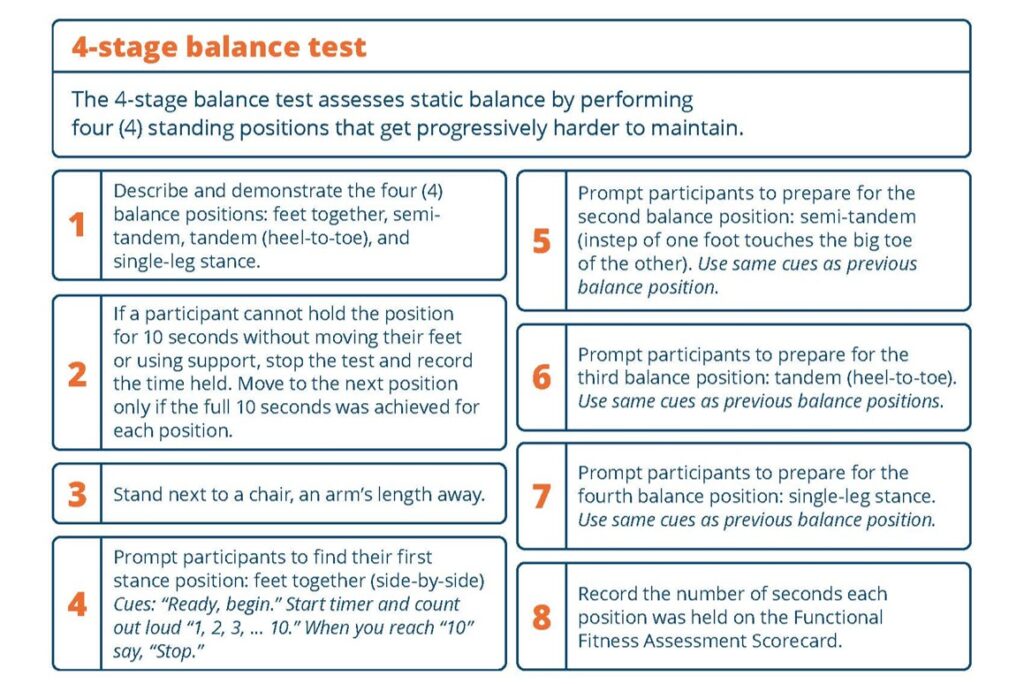
Each assessment should be demonstrated first prior to participants testing. Please note that the 4-Stage Balance Test includes four (4) different positions.
Encourage proper form and ensure each participant understands the objective of the test.
The 4-Stage Balance Test
Objective: To assess static balance by performing four (4) standing positions that get progressively harder to maintain.
Equipment Needed: Stopwatch/timer, armless chair for support, if needed.
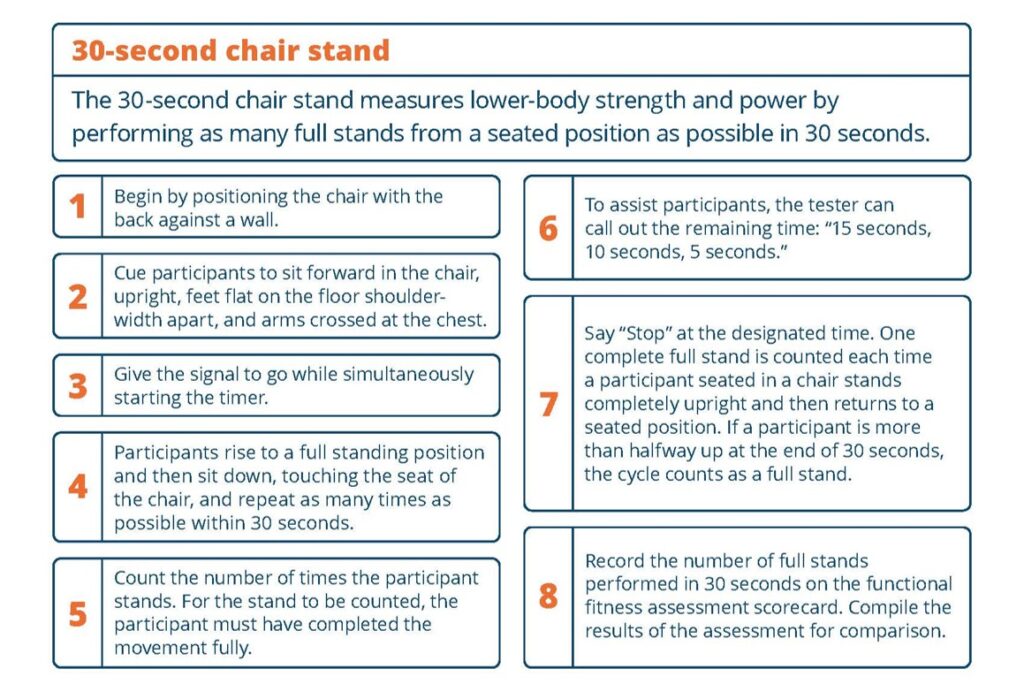
2) 30-Second Chair Stand Test
Objective: Measure lower-body strength and power by performing as many full stands from a seated position as possible in 30 seconds.
Equipment Needed: Stopwatch/timer, armless chair positioned against a wall.
Important Note:
The functional fitness assessment instructions are intended for your reference only and should not be distributed to class participants.
Record all scores using the Functional Fitness Assessments Scorecard. This document can also be found in the Instructor Resource section at the end of the course.
Ensure all results are recorded to support meaningful comparisons from the start to the finish of the program.
Ensure that each participant gets their own assessment scorecard back and takes it home for safekeeping. The week prior to testing, remind participants that they will have to bring the scorecard back to record their new scores.
If the test protocol is altered (for example, if a participant pushes off the thighs in the 30-Second Chair Stand) the score can still be used to measure personal improvement from the start to the end of the program. The goal is to help participants complete the assessment using the standard protocol over time, without modifications.
Adjustments may include:
Using arms to push off the thighs
Modifying the seat height
Performing fewer repetitions due to discomfort
In Summary
In the final two lessons of this unit, we’ll focus on education. You’ll learn how to guide participants through important balance and fall prevention topics, including how to identify and reduce home safety hazards, to help them make lasting changes beyond the fitness studio.