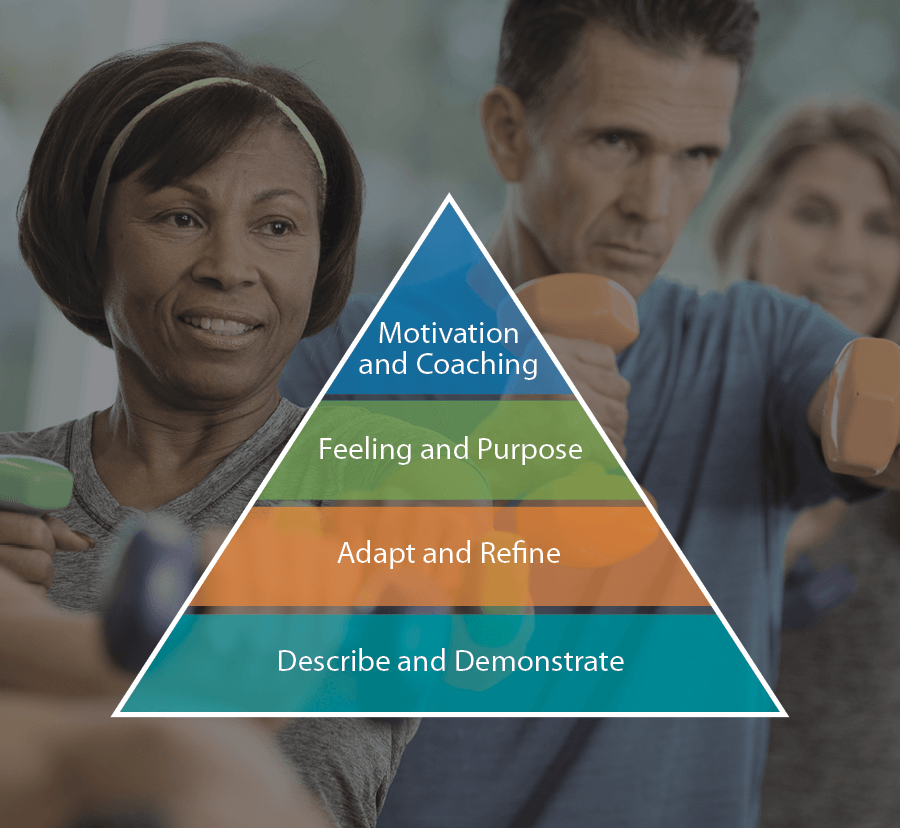
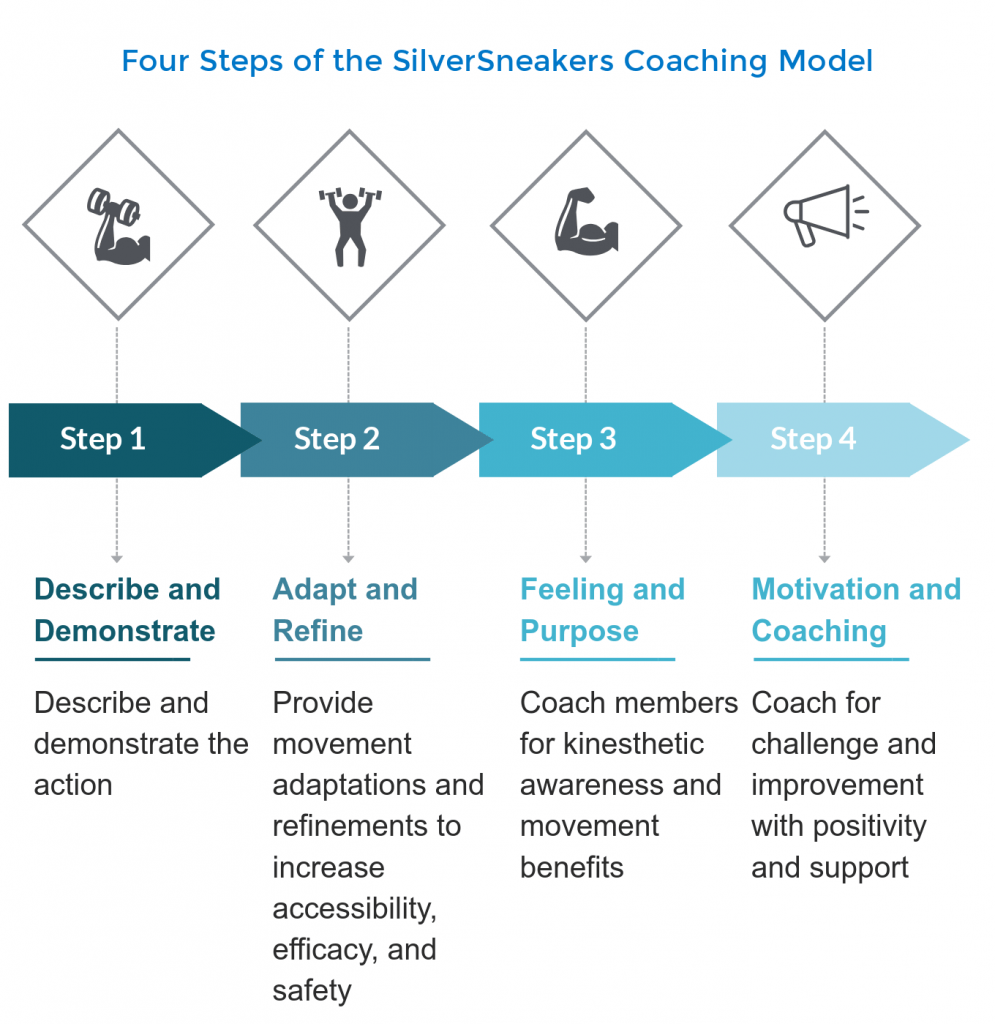
Cueing prepares participants to know what to do and when to do it. Coaching improves understanding and adherence while building relationships. Effective cueing is the first layer in successful coaching. It begins with thinking about what you want to teach and how you want to teach it for safe movement and transitions. The next layers after the initial delivery are to adapt and refine proper execution, establish purpose and meaning, and finally layer on feelings and motivation. Tone and body language connect a great experience.
SilverSneakers Way of Coaching
The SilverSneakers core training, Foundations, introduces the SilverSneakers Way of Coaching. When learning how to cue, focus on one area at a time. Begin with the base of effective cueing, describe and demonstrate. As discussed earlier, practice cues with as few words as possible, four to two beats ahead of the movement change. Focus on safe transitions and continuous flow. As you feel more confident in your delivery, layer in additional cues that provide refinement, purpose and motivation.
Below is a review of the four layers.
STEP 1
Name the exercise
Provide one to three cues for safety and execution
Describe and demonstrate the action
Example:
Say: Squat
Say: Feet hip width, chest lifted, abdominals engaged
Say: Press hips back while bending the knees
STEP 2
Utilize the correction sandwich approach for making adjustments and corrections:
Say something positive, refine alignment or make a correction, follow-up with positive reinforcement
Provide multiple movement adaptations, progressions and regressions
Example:
Say: For more intensity, move hips lower
Say: Keep thighs parallel to the floor or higher
Say: lf there’s knee discomfort, decrease the range of motion
STEP 3
Provide kinesthetic cues to teach participants where to focus or “feel” the exercise
Explain the “why” behind the exercise. Include activities of daily living
Example:
Say: Feel bodyweight pressing into your heels
Say: Building strength and endurance in the lower body
STEP 4
Encourage participants to challenge themselves
Provide positive motivational cues
Example:
Say: Just a few more!
Say: Your form is terrific!
Say: Feel yourself becoming stronger!
Guidelines for cueing and coaching:
Provide no more than one corrective action at a time.
Form and corrective cues should be sequential.
From the core and moving out to the extremities.
“Draw belly button in, chest tall, shoulders back and down.”
From the ground up.
“Feet shoulders distance apart, weight sitting back in heels, knees slightly bent, pelvis tucked.”
From the top down.
“Lift through the crown of your head, chin parallel to the floor, ears over shoulders, shoulders pulled back and down, chest lifted.”
Cues should be positive and solution-based.
Refrain from words such as “don’t” and “no.”
Build vocabulary to cue what to do as opposed to what not to do.
Remove filler words such as “the next exercise is” or “next you’re going to…”. Practice positive, direct cues with as few words as possible.